a passover story
My family has tended to affiliate with the free-wheeling branch of reform Judaism, and this year’s Passover Seder was no exception.
The mayhem of our Passover traces its history back to the go-go 1960s when Uncle Bob self-published the first of several abridged haggadot, the Passover story text, which he audaciously entitled A Passover Seder for my Family. In Uncle Bob's crisply worded eight pages he managed to preserve the essential elements of maggid, the telling of the story, and most important, the four cups of wine, some of which was added over the years to the cover of my booklet.
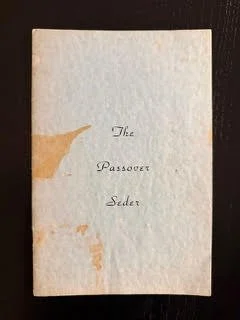
My older sister, Roberta, thought Uncle Bob’s eight-pager was too long. In a mere six pages, she succeeded in cutting all the waste, fraud and abuse of the prior versions, and even managed to add a couple of new and necessary elements, such as the acknowledgement of Moses’s sister, Miriam, and her heroic part in the liberation struggle.
I had forgotten but was reminded, during my research before this year's seder, of ultra-cool sister Miriam’s standing nearby as the Egyptian princess discovered baby Moses floating in his basket. When it became clear that the princess was claiming the rescued child for her own, Miriam played the princess like a Steinway:
“Your highness, I wish to apply for the position of the child’s nanny” she said, or something like that which we know to have been persuasive because she got the gig, assuring the survival of both siblings. From that courageous beginning, the siblings went on to assure the survival of the Hebrew people. And here we are to tell and retell the story, some 3200 years later.
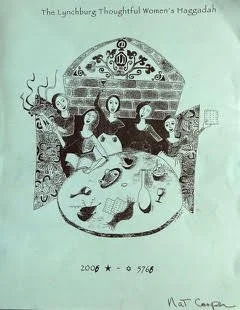
The family’s revisionist tendencies persist, so this year we added selected portions of the Lynchburg Thoughtful Women’s Haggadah. This rare book, signed by one of the thoughtful women, includes such feminist perspectives as the essential role of the Egyptian midwives. Anticipating the Geneva Conventions by roughly three millenia, Shiphrah and Puah refused the order—to kill the Jewish baby boys—and thus prevented Pharoah’s intended genocide of the Hebrew people.
Why are there not more Jewish baby girls named Shiphra and Puah?
As daughter and co-host Samm and I were assembling the prescribed items for the seder plate we discovered that our caterer had omitted a couple of items. A Passover seder without chopped liver may not be one of the Torah’s capital offenses, but contemporary Talmudic scholars, otherwise known as my uncles, would not have tolerated such an oversight.
Besides, I had already boiled the eggs I planned to use in case the caterer’s liver (no, not her actual liver) turned out to need doctoring. Samm immediately called the caterer, and was assured the chopped chicken liver would be on the delivery headed out.
We were also missing the shank bone of a lamb meant to symbolize the lamb’s blood the Jews were commanded to shmear over their front doors as a sign to the angel of death, in effect proclaiming You guys just pass right over this house.No Egyptians here.
Now, I’ve never been entirely comfortable with this particular symbol of plague #10. Killing the first-born Egyptian males would have been a textbook case of genocide by a so-called god who comes across as little more than a pathological narcissist. Seriously, why not just send a stiff breeze to blow pharaoh’s ass into the Red Sea? The question has to my knowledge never been seriously addressed.
Also, and more to the point, the current question remained: what to do about the missing shank bone?
I suggested that we might print out a clip art picture of a shank bone and lay it on the seder plate between the horseradish and the parsley. As usual, Samm had a much better idea. she got out her drawing pencils and drew one.

This year, our Passover gang included folks for whom this was a first seder. And because those particular people are Black, I felt it to be critically important to make explicit the connection between the Jewish and Black experiences with enslavement.
The teachable moment occurred when the telling of the Passover story reached the time when Moses implores Pharaoh to Let my people go. I am not a singer, but I did my best to render the song as it might have been offered in a Black church by a legitimate bass-baritone preacher.
With little if any prompting from me, the voices around our table—Jewish, Christian and atheist, Black and white, young and old, female and male—performed a persuasive rendition. I made the cross-cultural linkage explicit by offering that the repeated references to my people meant enslaved Hebrews and African Americans, and that Pharaoh referred both to an Egyptian king as well as a southern plantation owner. It also gave me the opportunity to mention the coded language of the Negro spirituals and their power to communicate and inspire the struggle for freedom.
So, what to make of this year’s seder? What has been added to the list of of traditions?
A line from the Lynchburg Thoughtful Women’s Haggadah is one of the take-aways. We were advised to remember and honor the ordinary people of Egypt, who were, as are we, victimized by their autocratic ruler.
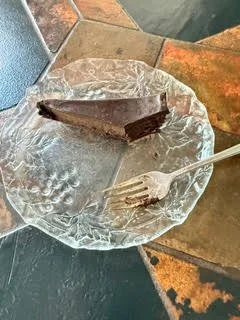
I’m pretty sure another new seder tradition has been launched. There’s a fudgy, flourless chocolate cake in my ‘fridge that appears to be missing one forkful. I’m thinking it was Elijah.