In terms of the myriad outrages of the Trump administration—the American Gestapo of ICE terrorizing immigrants and killing peaceful protestors, for example, or Trump plunging us into a war with Iran with absolutely no coherent strategy—the president’s latest outrage, savaging one of our greatest museums, might seem like small potatoes.
But it is not.
A new government report, released to coincide with the American semiquincentennial, accuses the National Museum of American History, the Smithsonian Institution’s crown jewel, of being hopelessly woke and run “by people who don’t want you to love your country.”
Over 160 anonymous pages, with some 500 footnotes, the report, produced by Trump’s Domestic Policy Council, accuses the Smithsonian in general and the NMAH in particular, of anti-white bias and of minimizing and distorting the nation’s founding. Those actions, an account in The New York Times asserts, have shifted the museum’s mission “from straightforward historical education and scholarship toward an extreme political activism that seeks to transform our country.”
The report is titled “Saving America’s Story: How Ideological Capture at the Smithsonian Institution’s National Museum of American History Erases Our Heritage.” It accuses the NMAH of “no longer treat[ing] the American story as a shared national inheritance to be taught or celebrated but as a political instrument to divide, dispirit and discourage our citizens.”
In fact, this screed was written ferociously, fecklessly and is rightly being condemned by serious scholars and others, including Pulitzer Prize-winning Washington Post culture critic Philip Kennicott.
“Just follow the footnotes,” Kennicott wrote, “and you quickly realize this is a relentlessly tendentious piece of trash.”
As someone who regularly has roamed the Smithsonian museums’ corridors, marveling at its thorough, impartial recounting of our mutual past—buttressed with a phenomenal array of historical artifacts—I find this administration’s wanton ignorance appalling. I have history with the Smithsonian's museums, including the NMAH, going back 50 years:
A handful of unique political buttons from my 20 years of covering national politics for the New York Daily News is in its permanent collection.
My portrait of Stephen King is in the Smithsonian’s National Portrait Gallery, part of its archive of American achievers. A portfolio of images from my book “Down East Maine/A World Apart” is promised to the Smithsonian American Art Museum.
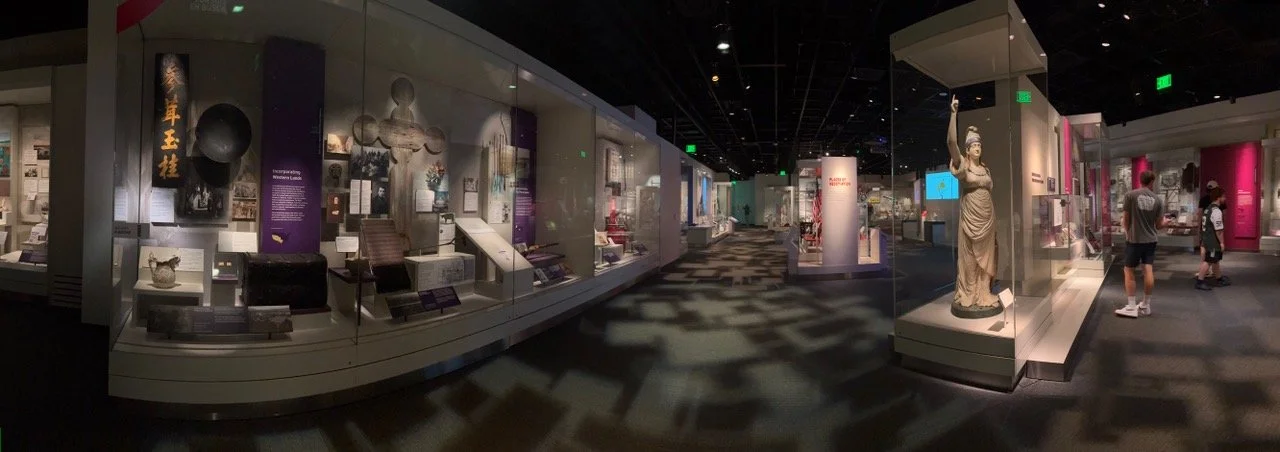
And just last week, my wife and partner Judith Goodman and I worked as “citizen historians” helping to document the “Life, Liberty and Pursuit of Happiness” exhibit at the NMAH. This all-volunteer effort was begun precisely to document existing exhibits—and, as important, text blocks--in the face of relentless criticism and interference from the crypto-Fascist Trump administration.
As a journalist and as an American I abhor Trump’s attempt to rewrite our history in his image by co-opting America’s museums, but also not surprised. Noted the Times:
“Mr. Trump has focused on the Smithsonian since March 2025, when he issued an executive order titled ‘Restoring Truth and Sanity to American History.’” In that order the president described a “revisionist movement” across the country that “seeks to undermine the remarkable achievements of the United States by casting its founding principles and historical milestones in a negative light.”
But, of course, Donald Trump—besides being a felon, pedophile and traitor (see Putin and Ukraine)—also is an idiot. Which means he gets the Smithsonian exactly wrong.
Philip Kennicott observes that Trump’s new bullying manifesto, arguing how the National Museum of American History “erases our heritage,” actually proves the opposite, “while scrubbing American history of everything that doesn’t fit officials’feel-good narrative of a country only incidentally marred by imperfections, all of which are safely in our past…”
He goes on:
“[W]ith the perverse logic of authoritarianism, this document is an accidental guide not just to how to do history right, but to many of the salient moments of struggle and ugliness that define the American narrative. The best analogy is, unfortunately, a key episode in the Nazi effort to rewrite German history and culture, the 1937 Degenerate Art Exhibition in Munich, which was shockingly comprehensive and prescient in its inclusion of many of the greatest artists of the day. In their effort to mock modern art, Nazi ideologues constructed a fairly thorough and reliable compendium of the best art, displaying works by Matisse, Chagall, Kandinsky, Beckmann and Kokoschka. The White House report is similarly thorough and misguided…”
Worryingly, I am compelled to add: decades ago, the Nazis were defeated and modern art flourished.
We should be so lucky this time around.
[A note on my political buttons: I did not set out to let go of some of my best pieces. In the 1970s, working on a Sunday magazine article about collecting political memorabilia, I interviewed the director of the museum’s division of political history, and laid out some of my buttons on his desk. He looked at them politely, but every so often would put his finger on a button and move it to the side. He selected about half a dozen and said he would love to have them for the collection. Frankly, I didn’t feel as if I could refuse. But I also felt very proud.]
Frank Van Riper is a Washington-based documentary and fine art photographer, journalist and author. (www.GVRphoto.shop)