I always hated the smell of cigarettes.
Both my parents smoked (my mother, filtered Winstons; my father, unfiltered Camels.) Chain smokers each, I’m sure cigarettes helped kill them.
“You can’t smoke until you’re man-grown,” my father would tell me. No worries on the cigarettes: the things stank and, on the few times I tried them and inhaled, it was as if someone had stuck a hot poker into my lungs.
But Pop was an equal opportunity smoker—not just cigarettes, but a pipe and cigars as well. And that was a whole other tub of nicotine.
Where cigarette smoke reminded me of burning garbage, pipe and cigar smoke transported me—much as it did the bouffant-haired blonde in the 1950s magazine ads swooning over the smell of her man’s pipe.
Not only was the smell much better—even from my father’s cigars—but you didn’t have to inhale to enjoy them. Talk about a healthy win-win!
During my college newspaper days at CCNY, I was probably the only newsie who regularly smoked a pipe, augmented every so often by really cheap cigars with plastic holders. The first were Tiparillos that weren’t even all tobacco. The wrapper was brown paper (I’m not making this up.) Later I moved up to El Producto Diamond Tips that at least had a genuine leaf wrapper.
So it went during my 20 years in the New York Daily News Washington bureau. In the late 60s and 70s I roamed the White House, Capitol Hill and environs with a pen, notebook, tape recorder—and a pipe and pouch full of Balkan Sobranie or Dunhill Standard.
I had all of two pipe-smoking colleagues back then: John Finney of The New York Times and Jerald terHorst of the Detroit News. Jerry and I were regulars on the presidential campaign trail, and I covered countless hearings with John, the Times’ veteran congressional correspondent.
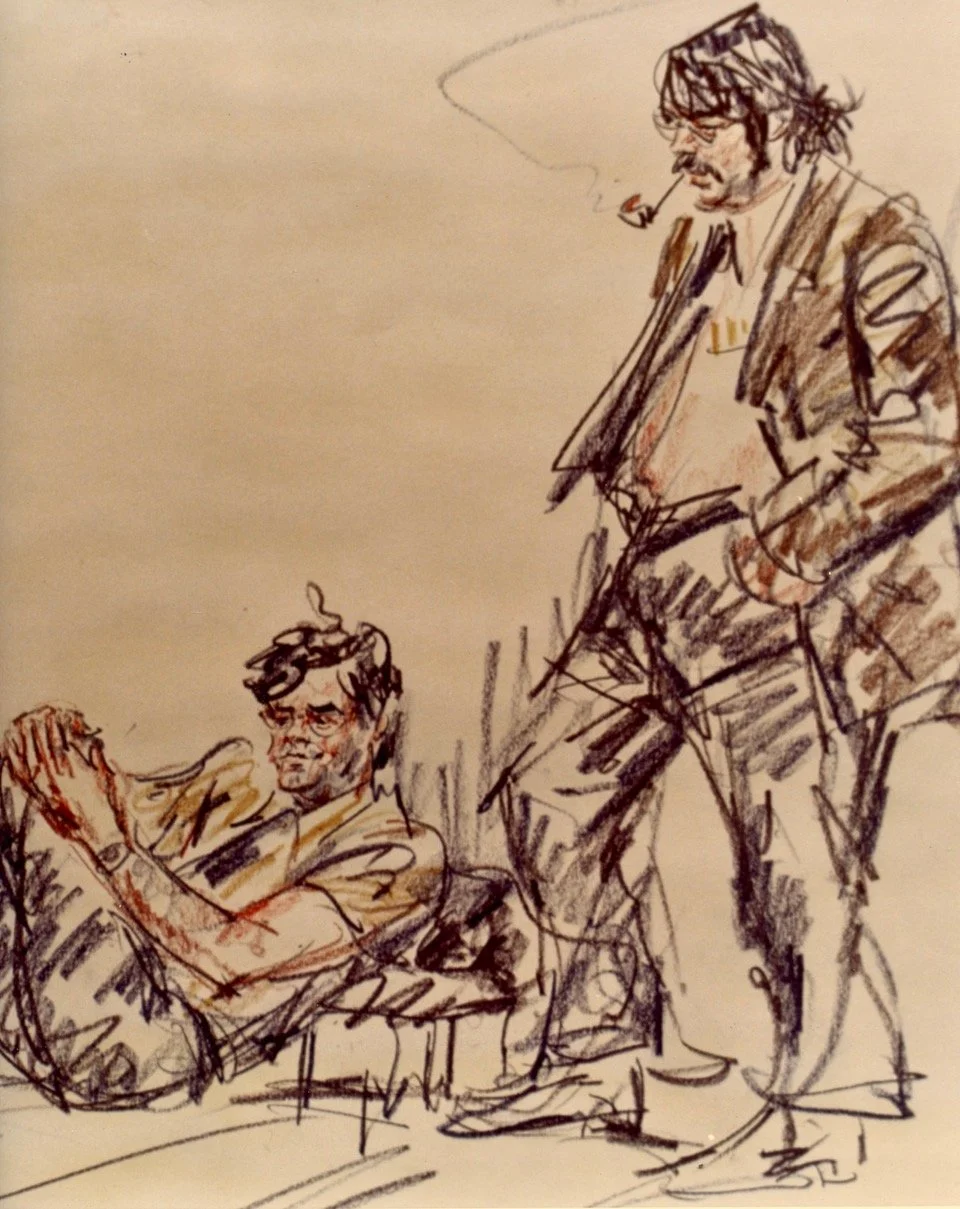
Smoking was allowed everywhere back then. Press tables at congressional hearings always were festooned with huge brown glass ashtrays that damn near every reporter used. [During Watergate, legendary courtroom and former WW II combat artist Howard Brodie sketched a group of rumpled, bored reporters killing time in the hallway of the U.S. District Courthouse covering the Watergate grand jury. I’m leaning on a wall in a wrinkled corduroy jacket, with a pipe clenched in my teeth. Howard even captured the smoke rising from my bowl.]
My pipe (or pipes—I owned about a dozen) puffed me through a multi-month marathon in 1983 writing my campaign biography Glenn: The Astronaut Who Would Be President. I was holed up in our apartment 12 hours a day, seven days a week while on leave to write the book. There was no way I could have gotten a cigar—even the very good ones I now favored—past my soon-to-be-wife Judy. That was an indoor bridge too far.
But I did strike gold the following year in Havana, when I traveled on a hairy-ass campaign ”peace mission” with then-presidential candidate Jesse Jackson. It was a week-long flying circus: we hit Cuba (twice) Nicaragua, El Salvador and Panama.
“If you’re going to Cuba,” a colleague had told me, “pick up some Montecristo Superiores—the cigars Fidel smokes.” In fact, they were on sale in the gift shop of our hotel, the Havana Libre, and I glommed onto two boxes. I even got my paper to pay for them, using doctored cash receipts for phone calls to the states—long story.) FYI: no problem getting the stogies into the U.S.: we were flying with Secret Service protection (Jesse being a presidential candidate) so we simply sailed through.
Given all these happy smoky memories, it might surprise that I went totally cold turkey on tobacco in the late 90s. I blame … er, thanks to, my grandson Max.
Max is now a frighteningly bright, handsome 30-year-old. Back then he was an irresistible little towhead. One day he came up to me, prompted I am sure by Judy and our daughter-in-law Johanna, looked at my pipe and implored through wide eyes: “Don’t die, Gpa.”
What the hell was I supposed to do?
That spell lasted about 10 years. I don’t smoke a pipe anymore—it is, after all, a lot of paraphernalia to lug around—but I continue to love good cigars. In fact, (now-Nicaragua-made) Montecristos or their equivalent, remain my favorite, accompanied by a fine single-malt.
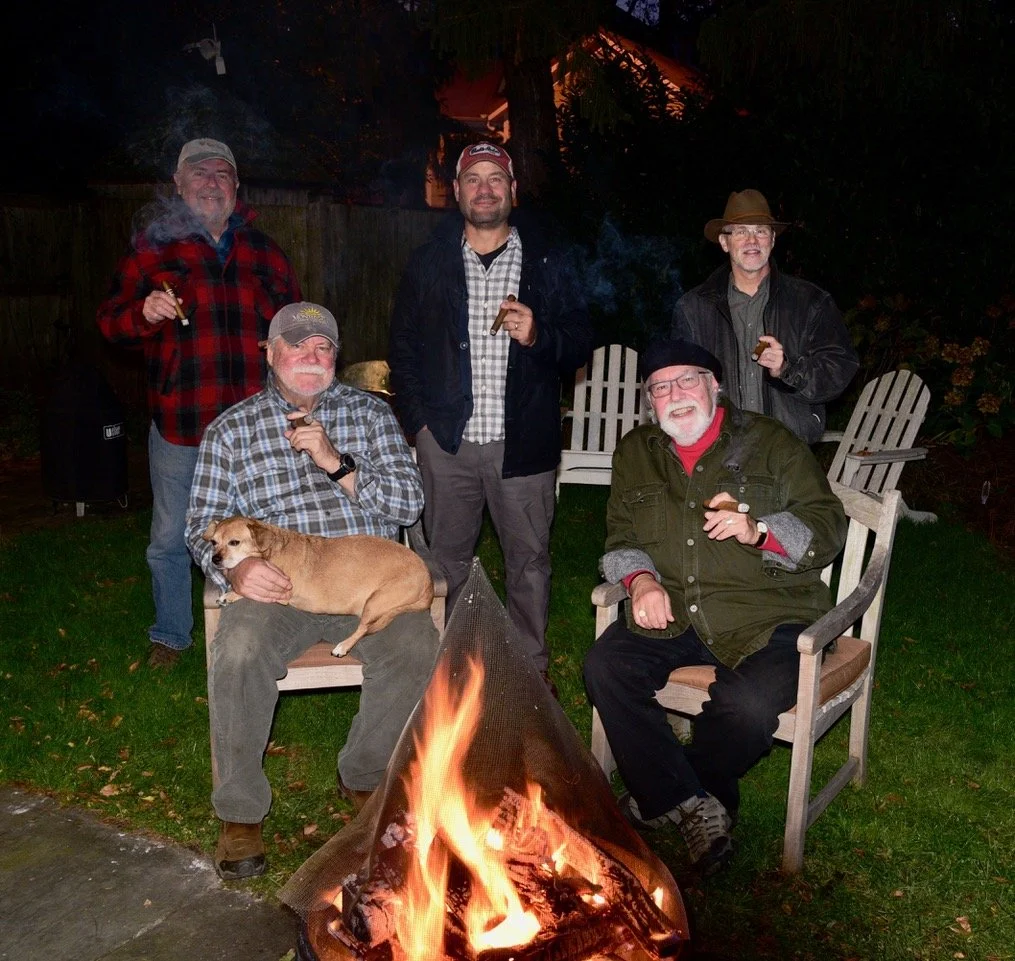
Our cigar group, author at bottom right.
I even have a regular Friday evening outdoor cigar group, and until recently was happily enjoying three to four cigars a week (roughly every other day). Then last January I got Afib and for way too long afterward had to go cold turkey again.
My docs tell me that my irregular heartbeat and dangerously high heart rate were triggered after Judy took a terrible fall in our bedroom one morning last October, hit her head and slowly developed a large subdural hematoma (brain bleed) that ultimately paralyzed her left hand and leg.
We both had assumed, since an early brain scan was clear, that Judy had suffered a stroke and that we’d now have to sell our lovely home and move into assisted living.
Can you blame us for being terrified? Or that my heart went nuts?
But once a second scan showed the brain bleed as the cause of Judy’s difficulty, the path forward was clear. Judy underwent emergency brain surgery to drain the hematoma and, amazingly, was nearly normal by the following morning.
Later, my heartbeat was zapped back to normal with a cardioversion and I have felt fine for months.
Out of an abundance of caution, however, I am down now to one cigar a week, on Fridays. But given all that has happened, that’s a very good outcome.
Frank Van Riper is a Washington-based documentary and fine art photographer, journalist, author and teacher.
*
For more on how we used to smoke and what the hell were we thinking, see Neil Offen’s memories of cigarettes past here.