

This is an excerpt from Don Moynihan’s Substack Can We Still Govern? You can read the full post here.
A year in, the pattern of democratic backsliding under Trump is undeniable.
The rise of authoritarianism feels more like a sprint than a creep. Whereas other authoritarians eroded institutions and asserted control over the course of years, trying to maintain a sense of normalcy, Trump is acting like a man trying to make up for lost time. It is not just that democracy in America is slipping: it is in free-fall.
The Financial Time data journalist John Burn-Murdoch has provided a visual confirmation of the speed of democratic backsliding in America. And it is striking.
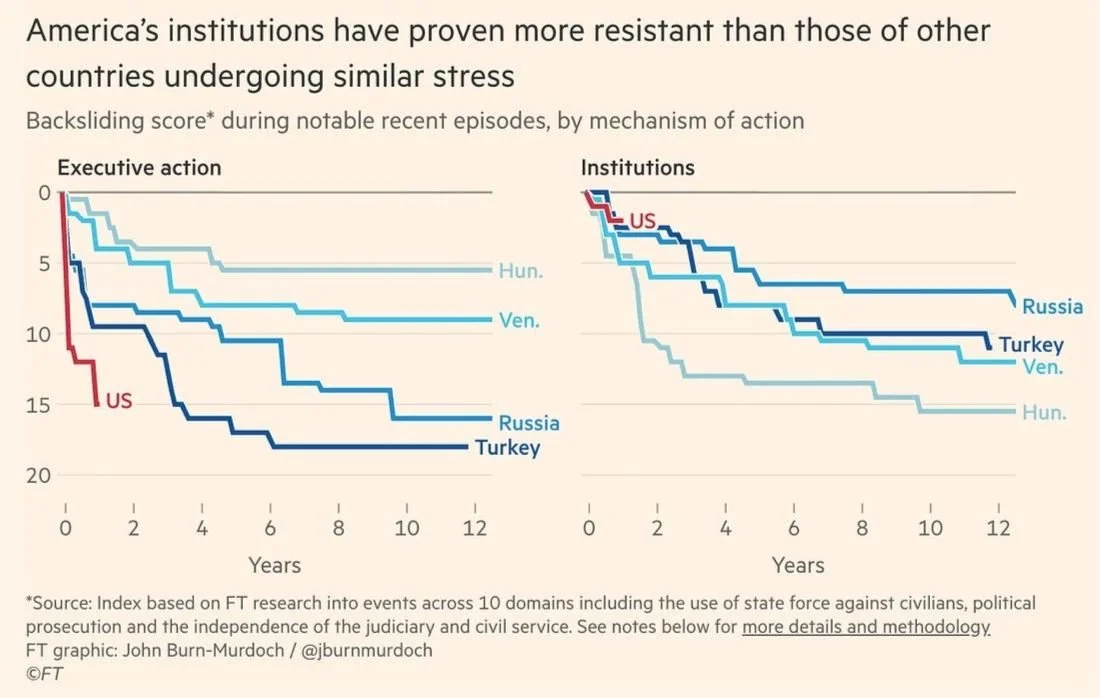
Murdoch does not mince words about what the data shows:
While U.S. history is hardly free from political violence or maltreatment of disfavored groups, this blitz on America’s citizens, institutions and — by many estimations — the constitution itself ranks as arguably the most rapid episode of democratic and civil erosion in the recent history of the developed world.
To come to this conclusion he looks at metrics like the independence of the civil service, political prosecution of enemies and the use of state force against civilians. You can read more about the data and methods he employs here, but for many of these criteria, the Trump administration does not believe there should be any limitations on its power.
It has proudly embraced a theory of government centered on personalized power and retribution. Civil servants should not be independent, political prosecutions are justified payback, and state force against civilians is necessary to maintain order.
Murdoch does find reasons of optimism. He distinguishes between actions by the autocrat and lasting policy changes. Trump has done more of the former, but less of the latter. He also notes that in the U.S. most of backsliding occurs via shocking abuses of power rather than Trump capturing other institutions. This offers, he says “a glimmer of hope for the US in the fact that many of its institutions and processes appear far more resistant to takeover than those that have crumbled underfoot elsewhere.”
We certainly need hope, but I might read the data a little differently.
Trump was able to get many institutions in line because they were already politicized (our legal system and Congress), or because he could scare them into submission, e.g., large sections of higher education, law firms or the media. Trump has not felt compelled to more aggressively pursue institutions because they have offered little resistance.
Let’s take a specific example. The President of the United States is asking the IRS to pay him $10 billion. This would presumably be coded as an executive action, one that has barely made a ripple, but is the predictable outcome of fellow Republicans on SCOTUS giving Trump immunity for actions in office.
I also do not expect such abuses to stop them from handing Trump more power over the executive branch. Unitary executive theory increasingly feels like a dogma that is turning the constitution into a suicide pact. The courts remain nominally independent, and many lower court judges are responding admirably, only to be constantly disappointed by the Supreme Court.