

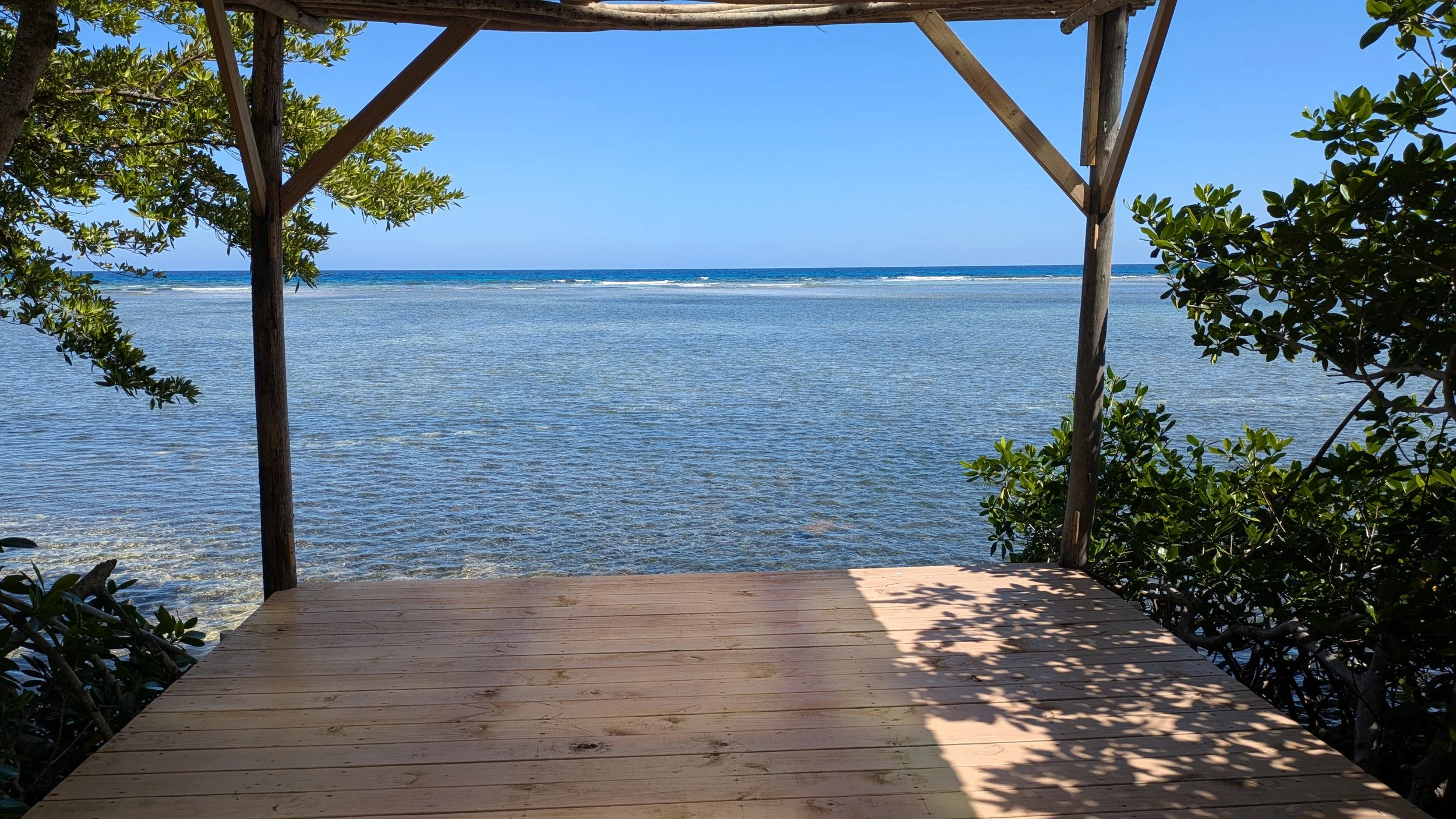
German met us at the southern end of the island after the sun descended. He carried four flashlights, one for each of us to hold and one to set on the edge of the wooden deck. It would guide us back to land.
We slid into the water and donned fins and masks. The sea and sky had lost light and color. German checked the flashlights. One blinked and failed. He shook it, but it didn’t wake. I’d brought a spare. We set it on a plank, pointing seaward. Nothing shone back. The islands near enough to see in daylight were uninhabited spits of sand ringed by mangroves. The island lights behind us had been turned low to conserve energy. We began to swim away from land.
Not far from the deck, Barbara’s flashlight failed. I gave her the one German had given me. She held it in one hand and with the other held to my rash guard. German paused. He said nothing, but waited to see if we chose to turn back. We put our masks into the water and swam outward.
The sandy bottom gave way to seagrass. We crossed it and entered a jumble of rocks and gullies. Now we were near the spit where ospreys had built a nest. In daylight we saw them leave and return with fish in their talons.
German turned his beam on two small creatures swimming upright. Their flanks were fine filaments that rippled. The infant squid looked like visitors from the ancient oceans. He then pointed his light downward, and something rushed from one pile of rocks, across the sand, and to another, where it hid.
We tread water, lifted our heads, and pulled our mouthpieces away.
“Did you see it?” German asked.
We had seen something formless shoot across the sand.
“Octopus.”
German turned and submerged again, still going outward, away from land.
We were a small halo of submerged light. Beyond the flashlights’ reach the PanAmerican Barrier Reef stretched for miles, and beyond it the Caribbean stretched forever. We were a group huddled around a campfire surrounded by forest, but breathing through tubes and nowhere to stand.
We followed German through the twists of the rock gullies, until we came to a small valley. He pointed to another formless body scuttling across the sand. But this one came more slowly. We watched as the octopus gathered and thrust itself. German dove and grasped a rock on the sea floor and tilted it upward gently. The octopus came toward him. It slid halfway into the opening German had made, then reached forth a tentacle. It held and caressed German’s hand. They touched for long seconds, until German, not the octopus, gently withdrew and lowered the rock again over the animal’s home.
We turned, and one of the lights glinted on something. I reached for Barbara’s free hand and turned her light toward the object. The barracuda, three feet long, hung motionless in the water. It had less interest in us than we had in it.
We swam calmly back across the seagrass. We lifted our heads, saw the flashlight on the deck, and swam to it. When we had almost reached shore, German’s other flashlights woke spontaneously, and we emerged from the water like a gala of bioluminescence.
This was the year I turned 75.
SD Williams's short story “Alex Sees Him on the Water” has been nominated for a 2026 O. Henry award.