

There have been quite a few periods in human history when new technologies jolted us forward and some significant old ways of doing or even thinking about things were, as a result, left behind.
Which were the most important of those periods of technological change in human history? I’m suggesting three of them.
How about this for the first, the oldest period of significant change: roughly five-and-a-half-thousand years ago in areas toward the center of the huge Eurasian continent? It produced these three crucial technologies, all of which likely manifested within centuries of each other:
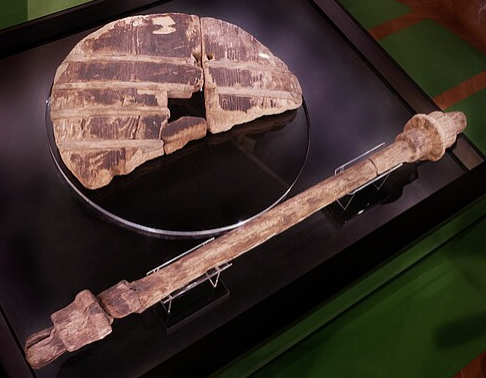
An image of the world’s oldest surviving wheel: approximately 5,100 to 5,350 years old.
The wheel (a design not employed by nature) was initially used to make pottery in Sumer in Mesopotamia (between the Tigris and Euphrates rivers, contemporary Iraq) about 3500 BCE. It may have taken some time before the Sumerians figured out that those wheels could be turned on their sides to make a cart. However, there is evidence that between 3700–3500 BC wheels had been attached to carts in copper mines in the Carpathian Mountains.
The horse was slowly domesticated and ridden with the help of bits placed behind their teeth. Soon they were attached to wheeled carts, later chariots—which then became decisive weapons of war, of conquest. The earliest evidence of horses being used for transportation, based on marks on teeth caused by the those bits, are from the Botai in what is now Kazakhstan, dating from 3700–3500 BCE.
Writing, which may qualify as humankind’s most transformative single technology, was also invented in that Silicon Valley of antiquity, Sumer—somewhere between 3400 and 3000 BCE. It served as a supplement to mere memory, but also as a device for preserving and transmitting human knowledge and, eventually, transforming the nature of that knowledge. Writing also appeared in Egypt at about this time. (I have long disputed the theory that the giant conceptual leap required to invent a way to make objects out of human language happened two more times: in China in about 1200 and by the Olmec in what is now Mexico, somewhere between 1200-400 BCE. It seems much more likely that the idea traveled across Asia and across the Pacific.)
These are surely among the most consequential of humankind’s technologies. The horse has by now had its day, but there were many centuries and places when it was transportation, when it determined who conquered whom and when messages got nowhere without it.
And the wheel has still not been replaced as the irreplaceable interface between the ground and something that humans want to move—from a airplane to a suitcase to a Mars rover.
And what in human thought did not benefit from the arrival of writing, which enabled knowledge to accumulate beyond the capacity of individual memories. And writing also allowed for the creation of new thought: the leap from Homer to Aristotle is a very large one.
Perhaps the most significant period of technological change: An otherwise nondescript period in human history: 1876 to 1903.
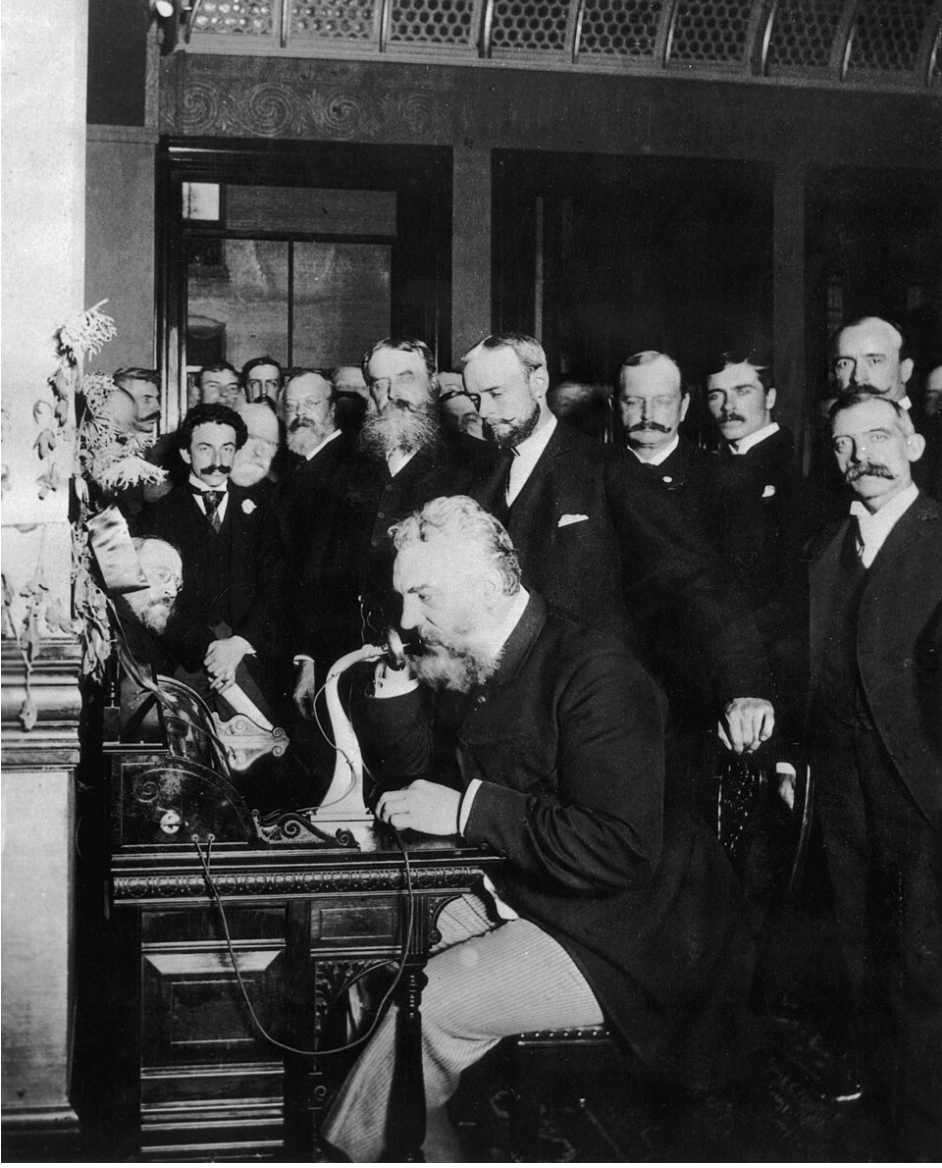
Alexander Graham Bell demonstrating his telephone in New York in 1892 by calling Chicago.
Alexander Graham Bell first demonstrated the telephone—the first method of transmitting voices on a wire—in 1876. And voices for the first time were separated from people.
The internal-combustion engine—which would eventually allow humans to move with considerable speed around the planet and considerably raise the temperature of the planet—was invented in Germany in 1885 by Karl Benz . (Note: We are not considering whether these changes were for the better.)
Guglielmo Marconi established the first human settlements on the air with the invention of radio in 1895.
Thomas Edison patented the first method of recording sound, the phonograph, in 1878.
Edison completed humankind’s long efforts to conquer darkness with the first practical electric light in 1879.
And together with W.K.I. Dickson, Edison captured life and enabled it to be transferred to a screen with the first motion pictures, first displayed in 1891.
And, of course, in 1903 Orville Wright made the first successful powered, sustained and controlled flight in a heavier-than-air aircraft, which he and his older brother Wilbur Wright had designed. Orville’s flight lasted 12 seconds and covered 120 feet. Cities, even continents, would soon be pulled closer together.
The most recent transformative period: from 1990 to 2015. When I asked ChatGPT for a suggestion, it came up with more or less this period. I didn’t think its examples were great and chalked this up to a kind of recency bias or a bias toward the time period upon which ChatGPT trained. But then I began thinking more about it.
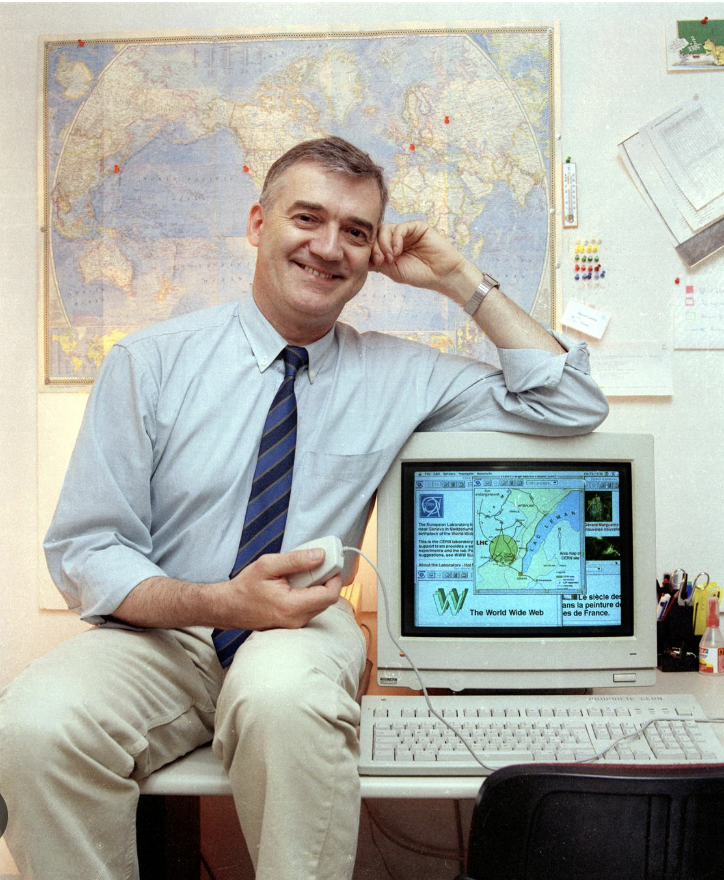
Tim Berners-Lee on the World Wide Web
In 1993, the World Wide Web—a system for creating, locating and accessing “web” sites on the internet, invented by Tim Berners-Lee—was made available, for free, to anyone. And the internet as we know it sprung into existence.
In 1995 Amazon—which would do nothing less than change the way much of humankind shops—went online as, quaintly, a bookseller.
Google, which had begun life as a Stanford project called “BackRub,” went online in 1998—not as the first search engine but as a dramatically new level of search engine.
“TheFacebook” was launched for Harvard students in 2004. It soon spread beyond that campus. And humankind discovered, in social media, a new way to shoot the breeze, to hang out, or to avoid physically hanging out.
A near-complete version of the human genome was synthesized in April 2003—radically expanding understanding of mechanisms through which we become ourselves and how those mechanisms can go awry and potentially be set right.
The first iPhone appeared in 2007, though it had a few awkward predecessors. And the smartphone rapidly became the most ubiquitous technology in the world—having usurped, for most of us, functions previously performed by the post office, the camera, the secretary, the typewriter, the map, the radio, the front porch, the hangout, the department store, the dictionary, the encyclopedia, the movie theater, the television, the calculator, the travel agent and, maybe, the friend.
Indeed, at the moment the smartphone seems capable both of being all and ending all.
And the smartphone, with the help of various other 21st-century technologies, has made it possible to build an alternative human civilization—where just about all human knowledge and entertainments are easily accessible by just about everyone—on the Internet.
Oh, and OpenAI was founded in December 2015 by Sam Altman, Elon Musk and others as a non-profit organization to research artificial intelligence.
See Mitchell Stephens’ book, the rise of the image the fall of the word (Oxford University Press), for more on the history and development of technology.