

Summer. Sweltering. The Statesville high school boys load their gear into the car. It’s driven by an older girl, a young woman. They head down US 21 toward Charlotte, the windows wide open to catch the breeze. Air conditioning has not yet been invented. Interstate highways do not exist. It is the 1920s.
At Charlotte they head east and make their way on blue highways through South Carolina. When they are hot and hungry, the woman pulls over and parks beneath a shade tree that has been left purposely to overhang the road. They eat food they brought from home. There are no fast-food restaurants.
By nightfall they have reached the coast and their destination, Pawleys Island, a slender square mile of barrier island. They have come for a week-long house party, a tradition. The young woman is an older sister of one of the boys and is their chaperone.
One of the boys became my father-in-law in 1981. Between his boyhood adventures and the day I entered his life, he’d been sent to England to prepare for D Day, married an English woman, landed on Omaha Beach and spent the rest of the war as a POW in Germany. Then came back to Statesville, and every summer, Pawleys.
Since joining the family, I have been to Pawleys every year but two. My 39-year-old son has been every year of his life. My 41-year-old daughter missed just a few summers when she lived in San Francisco and Cuba. My grandchildren have come every year of their lives. The ashes of my mother-in-law and a brother-in-law roll in the waves off the island’s north end.
You can read the island’s history elsewhere—the old salt works, the rail line that ended near the Pelican Inn, the hurricanes that ripped the island in two, the summer homes of the Low Country’s gentry and the rice culture that made them rich. Before the Civil War, South Carolina had the highest per capita income in the country. Slaves were not counted among the capita.
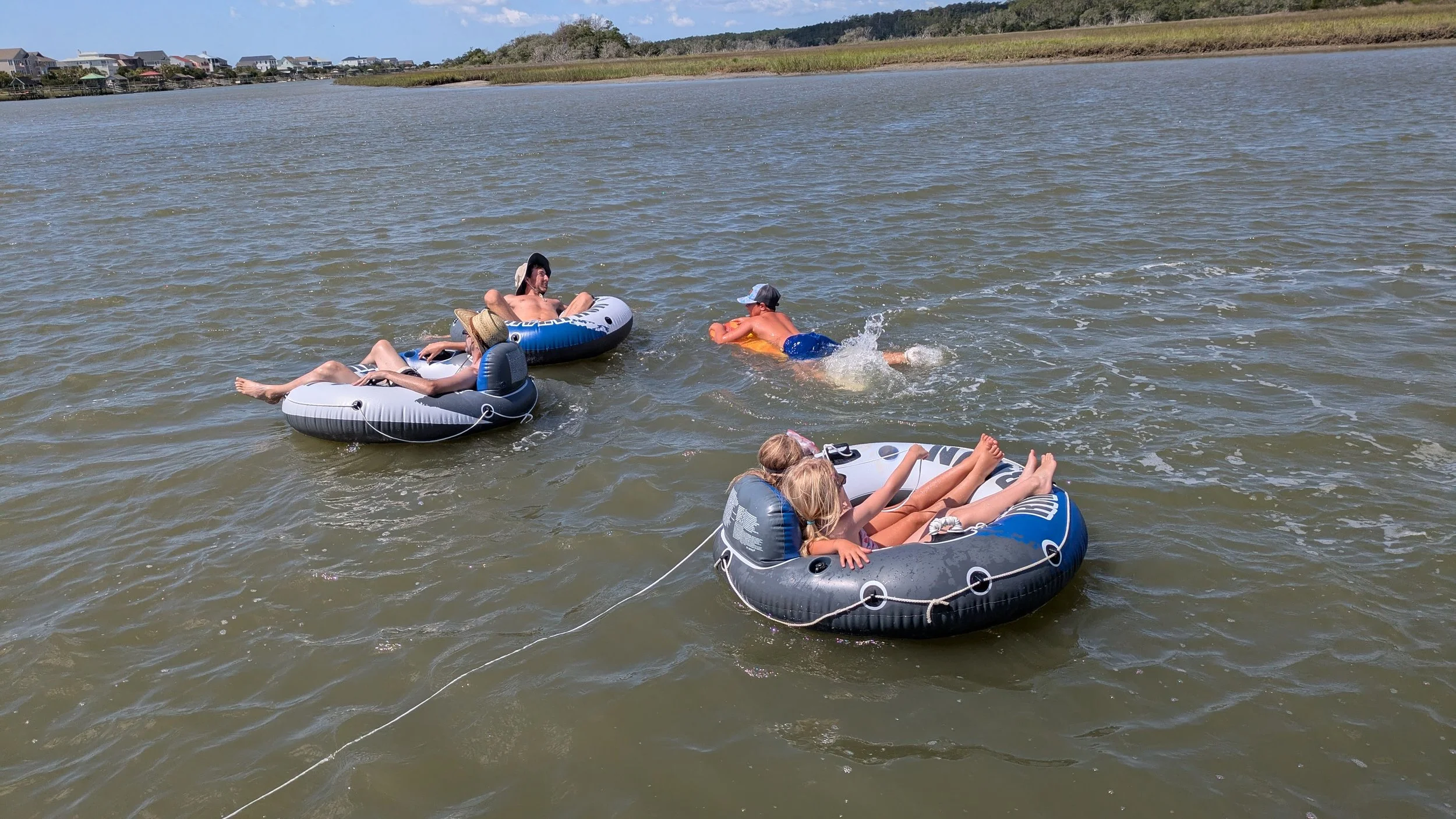
The good stuff, however, isn’t in the books. None of them mention the time my father-in-law, on the verge of old age, was sleeping in an easy chair one vacation-day afternoon despite the cacophony of grandchildren chasing each other around him through the cottage living room, screeching and squealing. One of them didn’t jump high enough and accidentally kicked my infant son, who lay on a palette on the floor. I picked him up, stood, and held him against my shoulder as he cried. The high-pitched sound woke my father-in-law. He looked up drowsily and asked, “What happened?”
I said, “One of the kids accidentally kicked him in the head.”
My father-in-law studied the situation for a moment, trying to swim up to consciousness. Looking at the boy high against my shoulder, he asked, “Well, how’d they get their foot way up there?”
He and his English bride had three daughters, and each daughter gave birth to two children, each pair a girl and a boy. Many summer talent shows ensued. My in-laws are now long gone, having bequeathed us tales that are repeated every summer. The daughters still come with their families, and some of their children have children of their own.
Every year we leave Durham, NC, and take the blue roads, eschewing the interstates. We drive through towns like Bugg Hill. We pass the sign for the Prayer Tower, an arrow pointing down a long dirt drive. We greet the dwindling population of shade trees that linger at the roadside. By late afternoon we have reached the coast and our destination.
I can now sometimes be found sleeping in a cottage living room on a summer afternoon, a book open on my chest. There are sounds from the kitchen and the sounds of children playing or fighting or both. An explosion of sound rises above the rest of the cacophony, and I wake, swimming, wondering what just happened, ready to save the family, ready to say something they’ll laugh about for the next 20 years.