

The poet Muriel Rukeyser once suggested that if even one woman told the truth about her life, the world would split open.
The first part seems to have happened when a Brooklyn teen mother and college dropout named Carol Klein changed her name to Carole King and started writing music. Then again, it was her husband, Gerry Goffin, who was writing the words. A new book in the superb Yale Jewish Lives series tells that story with real enthusiasm, and if the reader is left less than fully satisfied, that may be because we’re still waiting for the second part of Rukeyser’s prediction to happen.
As Jane Eisner tells it in “Carole King: She Made the Earth Move” [Yale Jewish Lives, 2026], King was the right voice at the right time, with a background we all know by heart. She was the grandchild of Russian Jewish immigrants fleeing persecution and poverty who found the American dream on the Lower East Side of Manhattan. Her parents met at Brooklyn College, married, and got down to business, raising a family and climbing out of the working class. So far, it’s a conventional, even predictable Jewish-American story, right down to the avoidance, sublimation, irrelevance or even rejection of Jewish identity.
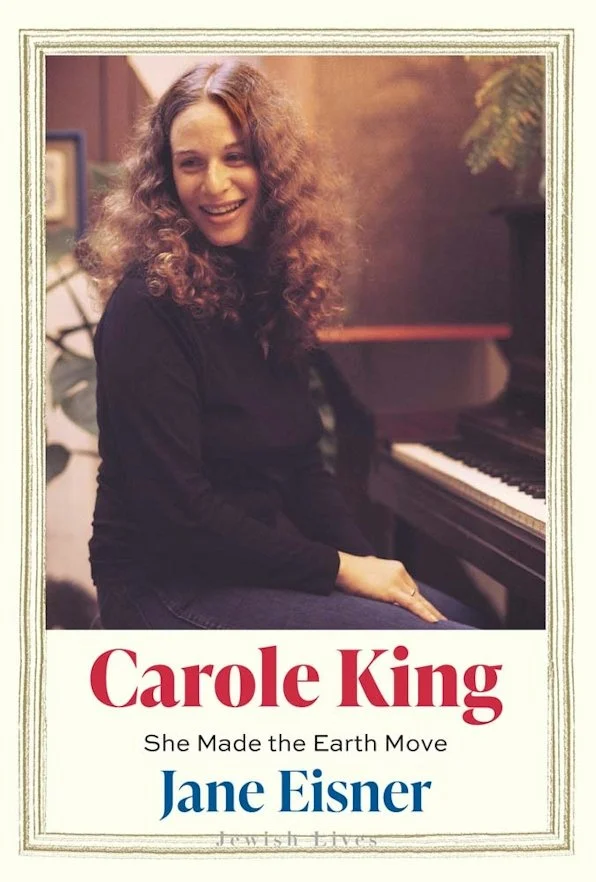
King herself was born Carol Klein in Manhattan in 1942 and grew up in Brooklyn. Her father was exempted from service in World War II because his job as a fireman was considered essential civilian work, while her mother was a homemaker and frustrated musician. Carol was a musical child who sang and danced along to the radio, a lively and naughty kid who learned piano from her mother, who was determined to see her daughter succeed. There were school musicals, and she appeared on television as Carol Kane starting at the age of eight, but there were also shameful secrets. They sent her disabled younger brother away to live at the infamous Willowbrook School on Staten Island, and her parents divorced, reunited and then divorced again.
Carol was rejected from the music division of the renowned New York City High School for Performing Arts—the model for the performing arts school in “Fame”— before being accepted in the acting department. She left after a semester and in 1956 enrolled in Brooklyn’s James Madison High School, a breeding ground for Jewish talent, including Ruth Bader Ginsburg and Bernie Sanders.
There she began writing songs and formed a doo-wop ensemble with the impossibly nerdy name The Co-Sines. She also began taking the subway into Manhattan. She haunted the neighborhood around the Brill Building, at Broadway and 49th Street, where hundreds of music publishers and record companies hired outer borough Jewish writers like Jerry Lieber and Mike Stoller and Burt Bacharach and Hal David to reinvent American culture, transforming rhythm and blues into rock and roll. No wonder “Carole King”—she added the “e” to distinguish her from the two other Carol Kleins who went to her high school, and she changed her last name from Klein to King to appear less Jewish—longed to join the assembly line operation that resulted in some of the greatest music of the American century, or any century.
She graduated from high school at the age of 16 and enrolled at Queens College, where she tutored Paul Simon in math and formed a group with him called The Cousins. It was also at Queens College that she met Gerry Goffin, who specialized in lyrics. They married in 1959 and had a daughter the next year. They also had an agreement to write material together for one of the dozens of music publishing companies that provided material for the exploding youth market. It has been said that the women of King’s generation, of every generation, were radicalized by motherhood, but King’s experience was different.
While Goffin left their Sheepshead Bay apartment every day to work his 9-5 job as a chemist, she stayed home, balancing a baby and a notebook. When Goffin came home each evening, more often than not King had come up with tunes like “Take Good Care of My Baby," which was a hit for Bobby Vee in 1961.
Lightning struck for King and Goffin over and over throughout the 1960s. Part of this was about technology, in particular the development of the transistor radio, which meant that recorded music was now portable, liberated from the concert hall or living room. The other part was about race. In the mid-1950s, the music known in Black communities as rhythm and blues was being remarketed as rock and roll for white teenagers who heard in the music a form of liberation—of the body and the mind—that classical music or show tunes lacked.
Eisner deserves credit for taking piano lessons to understand the inner workings of King’s craft, which re-engineered the relation between verse, chorus and bridge, and which featured a complex interplay between melody and text. Then there was what became known as the “Carole King chord” (really just the clever use of altered chords) that appears on her very first hit, “Will You Love Me Tomorrow?” written at the age of 17.
The song, which left the Shirelles initially unimpressed, perhaps due to the song’s bracing gender ventriloquism, in which a male lyricist expresses the fears and longings of an adolescent girl, became the first number one hit by a female African American group. Remarkably enough, King arranged the song, including an orchestral accompaniment, in one night, using a book on how to arrange music that she took out of the local library. She had just turned 18.
The song she wrote for her daughter’s babysitter, Eva Boyd, soon to be re-christened Little Eva, became the chart-topping “The Loco-Motion” in 1962. Little Eva, whose boyfriend was anything but the tender lover of most pop hits, was also the source of “He Hit Me (And It Felt Like a Kiss)” for the Crystals, a lyric that has become a key piece of Second Wave Feminism lore for its deeply disturbing exploration of internalized misogyny. Or, since Goffin wrote the words, was it just the old-fashioned kind?
The Beatles were great admirers of King and Goffin, including “Chains” on their first album in 1963, and before the year was out “Up on the Roof” became a hit for the Drifters, and “One Fine Day” put the Chiffons on the charts.
Then things changed. Their publisher was sold, King and Goffin moved to New Jersey, and the British Invasion on the one hand and the Folk Revival on the other meant that tastes in popular music were being transformed by the nascent counterculture. Marriage was changing, too.
Goffin fell in love with and had a child with one of the singers from a group called the Cookies. He also began experimenting with drugs, which was never something that King, who was after all taking care of their home and daughters—now there were two—never felt inclined to do. Still, King stayed with Goffin and they continued to work together. She even wrote the 1964 song “I’m Into Something Good” for Goffin’s other woman, though it didn’t become a hit until recorded by Herman’s Hermits.
Eventually, King fell in love with the young bass player for a local New Jersey band called The Myddle Class. Meanwhile, Goffin was diagnosed with schizophrenia, depression and bipolar disorder. Electroshock treatment followed, but King and Goffin were still able to work together.
After the legendary producer Jerry Wexler, who was looking for someone to write a song for Aretha Franklin called “Natural Woman,” stopped King and Goffin on the street in New York City and suggested they give it a try, they went home to New Jersey, King put the kids to bed, and wrote the gospel number—it uses a device called a plagal cadence that is a staple of African American religious music—that is perhaps their finest work.
Later that year the music business moved to California, and King followed, splitting up with Goffin and setting up house with her daughters in Laurel Canyon, the Los Angeles neighborhood that was known as “Hippie Heaven.” With neighbors like James Taylor, Joni Mitchell, Crosby, Stills, Nash and Young, King blossomed—hey, it was the sixties! She traded in her white Cadillac for a black convertible, grew out her curls and bought a sewing machine. She found a new collaborator, an LA native named Toni Stern who wrote poetry and had connections in the West Coast music business, and got to work.
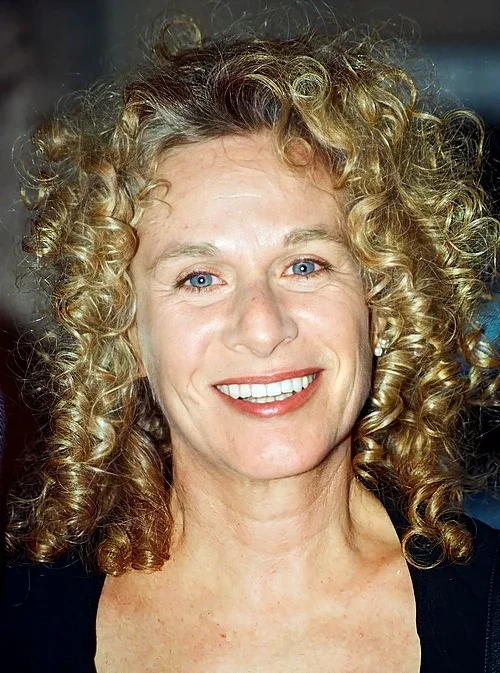
King’s solo debut was called “Writer” (1970), and while it was a successful record, it was nothing compared to the landmark “Tapestry” (1970), which was recorded over three weeks in January of 1971 for $22,000, which even back then was a pittance.
The result was monumental, a beloved landmark that transformed an entire generation of women and men, one that is still transforming them, perhaps because it is perhaps the signal, musical demonstration that the personal is political. King’s newfound sense of freedom was directed not outward, towards issues involving race or Vietnam or politics, but inward, in the manner of the confessional poets of the same era.
Eisner makes a good case for “Tapestry” as one of the first albums conceived of as a single, unified work of art, as opposed to “concept albums” like the Beach Boys’ “Pet Sounds (1966), the Beatles’ ”Sgt. Pepper” (1967), the Mothers of Invention’s “Freak Out” (1966) or Frank Zappa’s “Absolutely Free” (1967). Indeed, while side one explores freedom and solitude (“I Feel the Earth Move,” “So Far Away,” “It’s Too Late,” “Home Again, “Beautiful,” “Way Over Yonder).” Side two faces the social and the collective, with “You’ve Got a Friend,” “Where You Lead,” “Will You Love Me Tomorrow?” “Smackwater Jack,” “Tapestry,” “(You Make Me Feel Like A) Natural Woman”).
These songs are all but scripture for second wave feminists, and rightly so. They helped reinvent femininity just as the baby boomers became adults. Indeed, there’s a good case to be made for “Tapestry” being responsible for the process. There is an unapologetic honesty and raw intimacy, barefoot and un-made-up, in these songs. They sound like Laurel Canyon’s Wonderland Avenue but feel like Flatbush Avenue in Brooklyn: effusive and introspective at the same time.
Only Joni Mitchell’s “Blue” comes close, and it’s no coincidence: the albums were recorded in the same studio at the same time, sharing personnel. “Tapestry” topped the pop charts for three months, making it the most successful album in the history of the American recording industry, winning four Grammy Awards and putting King on the cover of Time magazine. Why? Because it told us our own bittersweet story just as we were developing the language to understand it. If the baby boomers lost their virginity to Sinatra’s “In the Wee Small Hours,” they got divorced to “Tapestry.”
And then? King followed up “Tapestry” with a third child (delivered in the kitchen) and a new album, “Music,” which also went to number one. But she never again reached the heights of “Tapestry” in the two dozen solo albums that followed. And though she performed regularly, in the United States and abroad, often while pregnant, she had no wish to be a star, and being on stage didn’t come naturally to her. Nor was trading on her appearance or her sexuality an option. She taught yoga and became a follower of Swami Satchidananda, and had another baby, in the kitchen of a new house in Laurel Canyon, and divorced again. Hey, it was the seventies.
But the composer of “Where You Lead, I Will Follow” was still, as they say in California, “in development.” Her third husband was a gorgeous, homeless jailbird from Idaho who never finished high school, and it was a difficult, abusive marriage (King eventually regretted writing “He Hit Me (And It Felt Like a Kiss)”), but King nonetheless settled with him and her children in Idaho—hey it was still the seventies!
Widowed at 36 after her husband died of a drug overdose, King found a new partner, a survivalist who settled her in rural Idaho, where they lived in a one-room home without running water, electricity or a telephone. They married in 1982 and moved even deeper into the Rocky Mountains, spending most of their time feuding with the federal government over land issues. But King kept making music and became increasingly committed to liberal politics, in particular environmentalism.
After divorcing in 1989, she moved back to southern California, mostly to help prepare her son for his bar mitzvah, with a rabbi, lawyer and music company executive named Stanley Levy, who had founded a non-denominational Jewish community called B’nai Horism (“Children of Freedom”}. The process represented less a return to her Jewish roots than her first exposure to them.
In the decades that followed she remained visible. She acted on the television show “Gilmore Girls” and started a website where in addition to the music, you can buy Carole King t-shirts and a ”Tapestry” travel mug—hey, it was the 1990s! And then was the Broadway musical “Beautiful,” which told the story of her life in music, downplaying the disastrous marriages and foregrounding the hits and the kids (the fictionalized version is on display in the wonderful 1996 film “Grace of My Heart”). Honored by Barack Obama at the White House, she published a best-selling memoir, and from her home in Idaho remains committed to progressive politics.
Clearly, this was a career filled with firsts and mosts, but at times Eisner’s research is rather lightweight, often drawn from popular internet sites, or even worse, YouYube comments. Eisner did enough legwork to discover that the house King and Goffin bought in West Orange, NJ, still has a doorbell that chimes out the melody to “Will You Still Love Me Tomorrow?” But if the book manages to explain King’s significance, it fails to capture her essence, perhaps because King is such a unique character, both musically and personally. Eisner, the former editor of the Forward, is a journalist, not a scholar, and it shows.
The bigger problem has to do with whether King belongs in this series at all. One might think that King deserves a fuller, deeper, smarter biography, one that engages more seriously with her Jewish heritage. But what connection or significance does she have for Judaism, or vice versa, aside from the accident of her birth and a connection late in life to Stanley Levy?
Her grandparents simply didn’t talk about the Old Country. Her parents gave her no Jewish education, nor were they particularly invested in the Zionism or socially progressive causes or Jewish culture that can sustain the tribe. King seems to have belonged to the first generation of American Jews to grow up with any experience of anti-semitism, though one suspects that Eisner might have brought a more sophisticated attitude to that assertion. The waves of anti-communism that rolled across the American landscape in the 1950s were powered in part by the hatred of Jews, whose progressive politics were considered insufficiently patriotic.
There’s certainly little in the way of Jewish identification, secular or otherwise, in the way she lived her life, at least until recently. Nor does Judaism seem to appear, explicitly or implicitly, in her work, as it does with Bob Dylan or Leonard Cohen. Of course, there’s nothing wrong with that. It is after all the price—or the reward?—of galut. Still, it’s a shock to track down the 2014 episode of Henry Louis Gates’s “Finding Your Roots,” less because we learn how little King knew about her Jewish background than how little she has to say about it. Even some resistance, a la Lou Reed, would help. Then again, why should we insist that she carry that burden?
Perhaps Eisner should have gone back to Freud’s preface to the Hebrew edition of his works, in which he claims that it is not in practice or in knowledge that he identifies as a Jew, but in essence. But if we learned anything from feminism, it’s the danger that essences pose. After all, it’s King’s lover who makes her feel like a natural woman. Her daughters, one hopes, will be able to do it for themselves. Or better yet, they won’t worry at all about what constitutes a “natural woman.” And we ought to remember that the title and the lyrics were both dreamed up by men.
The fact that King peaked so early is perhaps an invitation to wonder why some truly brilliant musicians of her generation—think of Stevie Wonder or Brian Wilson—had no third act, in the manner of her old school friend Paul Simon or her old friend and collaborator Joni Mitchell.
”Tapestry” was the soundtrack of second wave feminism in all its contradictions—beautiful and imperfect, alone and connected, demanding and needy. But the binaries had an expiration date, and after writing more than 100 hit songs, King’s relevance faded, just as the movement moved on. Or maybe there’s still time for that third act.
Is Rick Rubin, who performed late career magic with Johnny Cash and Neil Diamond, listening?
This book review appeared originally in Dutch in De Vrijdag Avond.