

The '63 Bug came to me the way a lot of cars did in those days. A guy at the corner tavern was looking to sell it for $100, and my dad relayed the offer to me. I was 17 at the time, 1973, and was making money for college by buying and selling used cars. The OPEC oil embargo had driven up gas prices and made economy cars appealing. Bugs were cute and had a 1960s romantic aura about them. If I could put the car in good shape, it would be an easy re-sell.
"Sure, let's take a look," I said.
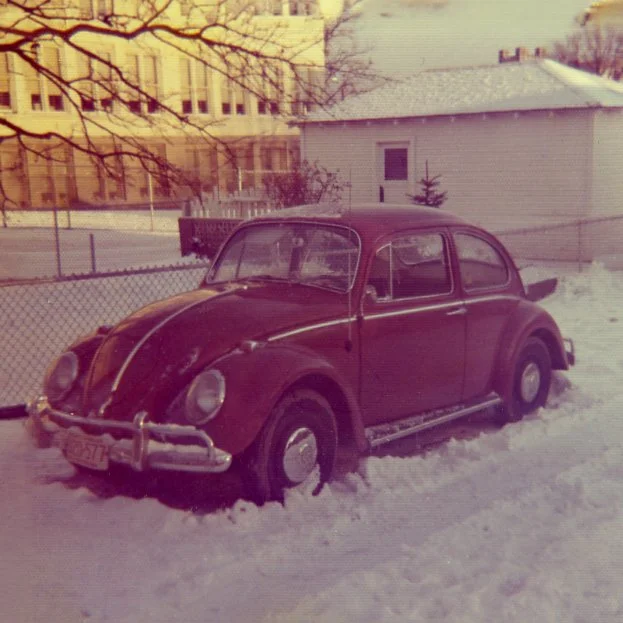
Another of the author's college-fund project cars, this one a 1966 Bug. The 1963 seems to have come and gone without leaving a photographic record.
The car was a sun-faded red, with the usual Wisconsin rust along the bottom of the doors on both sides. There was a golf-ball-sized ding in the right front well wheel and the headlight lens was cracked. One hub cap was missing. The interior was clean, albeit with no radio. There was still some life left in the tires. It ran well, and a short test ride revealed no problems with the brakes, clutch, or steering. It was loud and would need a new muffler.
I knew what needed to be done. I just had to figure out how to do it.
Repair was part of my world as a working-class kid whose parents were born in the early 1930s. Their parents had instilled in them a Depression era mend-and-make-do attitude. That attitude got passed down to my generation. It helped that the men in my family were tradesmen with the skills to fix just about anything. Or so it seemed to me. The women, too, fixed things—clothes mainly, but small household items as well. Repair, I learned, was the default response when something wore out or broke.
My first forays into repair involved bikes and lawnmowers. My dad taught me how to fix flat tires and repack the bearings on the 20-inch Schwinn Typhoon I'd gotten for my seventh birthday. Each job of repair or maintenance came with the message that, as I got older, I had to take responsibility for keeping my things in working order. There was nothing wrong with seeking help if necessary. But I was also given to feel that there was virtue in developing a capacity for self-reliance.
Later, fascinated with small engines, I started messing around with lawn mowers. I was 12 when I talked a neighbor into giving me a decrepit mower that wouldn't start. By then I'd read enough to know that if an engine had compression and spark, it could probably be made to run. I replaced the air filter, rebuilt the carburetor, and, sure enough, got the mower going.
I used a file to sharpen the blade, making sure to keep it balanced. After a thorough spiffing-up, I sold it for $25. This was proof of concept for what I would later do with cars.
Even though I'd worked on a lot of other cars, the Bug needed work I'd never actually done. I'd never patched a rusty body panel, or replaced a muffler or installed a radio. But I knew it was all doable, because other people did it all the time. I could also see that the work was not far beyond the reach of my skills; it was mostly cosmetic stuff. And, if need be, I could get advice from my dad, uncle, or gearhead buddies. I wouldn't have thought to say so at the time, but my youthful confidence was rooted in a community, one I took for granted.
I thought I'd tackle the easy job first: replace the muffler.
As it turned out, the bolts holding the original muffler on were so badly rusted I had to use a hack saw and a chisel to get them off. It took hours. I tried for days to find a junkyard replacement—with no luck. A buddy who knew Bugs said I'd be better off ordering a new muffler from J.C. Whitney. I didn't want to spend the money but it seemed I had little choice.
The new muffler arrived in a couple weeks (these were the days of mail order) and bolted right on. Not being able to find a cheaper solution was a small defeat, but I'd saved myself a lot of aggravation.
The doors were next. I knew that a repair with Bondo—a harden-able polyester resin that can be used to fill dents in metal—wouldn't last and would probably look like crap. An auto body pro might have been able to make it last and look good, but I'd seen so much bad Bondo work that I decided a better option was to replace metal with metal.
I'd taken a sheet metal class in high school—a trade and technical high school called, at the time, Boys' Tech, later Milwaukee Tech, and now Bradley Tech—and I had a rough idea of what to do.
I cut away the rusted part of the door panels, formed replacements out of sheet metal from the hardware store and pop-riveted the new metal into place. I took a strip of metal I'd cut away from the door to an auto body shop that sold touch-up paint in spray cans. We came close to matching the faded red of the Bug. After priming and painting, the new panels blended in acceptably well. The rust was gone and the repair would last a while.
The car still needed a new headlight lens and a chrome trim ring that surrounded the headlight. The car also needed a radio. It was the year of Crocodile Rock, Killing Me Softly with His Song, Bad Bad Leroy Brown, Kodachrome, Smoke on the Water and Midnight Train to Georgia. As I saw it, imagining someone like me buying the car, a radio was an essential connection to the world and a strong selling point.
The nearest junkyard that had lots of Bugs occupied an old industrial site along the Kinnikinnick River, between our southside neighborhood and downtown Milwaukee. I brought my toolbox and wore my mechanic's clothes. I didn't expect anyone to just hand me the parts I was looking for.
What was common then doesn't happen anymore. Almost no junkyard— or "salvage yard" as such places are called today—will let customers wander around and pull parts. The liability risks and fear of litigation are too great. And just about everything a modern salvage yard might sell is inventoried in a computer database. Buying parts from a junkyard is now as much of an adventure as buying from Auto Zone.
I told the crusty old guy in the office what I was looking for, and he directed me to some likely corpses in the yard. "You might want to take one of those along," he said, pointing to a row of battered shopping carts.
It didn't take long to find a headlight lens, trim ring, hub cap and an antenna I thought would work. The radio and speaker I needed I found on a shelf in the office. "With the radio, speaker and this other stuff," I said, "how much?" The guy took his cigar out of his mouth and looked back and forth at the radio on the counter and what I had in the cart. "Twenty-five bucks sounds about right," he said.
Before dealing with the headlight assembly, I had to do something about the ding in the wheel well. I asked my dad for ideas. He looked at it and said I could probably pop it out with a plunger (yes, a toilet plunger) and a rubber mallet. To my amazement, it worked. Some pulling with the plunger and a few underside whacks with the mallet brought the metal back nearly to its original position, leaving only a barely noticeable crease. I drilled a hole to mount the antenna and installed the speaker and the radio. It sounded tinny if you turned it up too loud, but that hardly mattered for listening to AM pop.
With the new headlight lens and trim ring, and the newly smoothed-out wheel well, you had to look carefully to see that anything had been amiss. Up close anyone could see that new metal had been added to the doors, but from a distance they didn't look too bad. All in all, the Bug now looked solid, much better than the $100 beater I'd rolled into the garage a few months earlier.
As much as I remember about this project, I don't remember how much I got for the car. I recall that it sold quickly, with no hassles, and I came out ahead, though less far ahead than I'd hoped because of having to spring for a new muffler. The Bug probably went for $400 or $500. That was enough to make the project feel like a success.
To put that sale price into perspective, my first semester's tuition, at a state university in the fall of 1974, was $600.
I continued working on cars through graduate school, in large part out of necessity. During those years I couldn't afford to pay anyone to fix my cars. Later, after I got my first real job, affluence set in and I didn't need to drive cheap, dubiously reliable cars anymore. By the mid-1980s cars had changed, too. Fuel injection, electronic ignition and computer-based diagnostic systems made my skills obsolete.
The timing light my parents gave me as a Christmas present one year when I was in high school I never used again.
Michael Schwalbe is professor emeritus of sociology at North Carolina State University. His most recent book is The Spirit of Repair (Horse & Buggy Press, 2026).