


What’s Really Annoying
Ten of the most annoying things about modern life today, not including, of course, the president of the United States:
10. Produce bags at the supermarket that you can’t figure out which end to open and then once you figure that out which end to open you still can’t open without rubbing the two sides together and hoping they come apart.
9. Political emails beginning with the phrase, “Will you chip in today”? And political emails, usually from a candidate you’ve never heard, ending with “Will you chip in today?”
8. Gas station pumps that start playing loud audio/video channels as soon as you start pumping. . . .

Dancing Toward Death
My generation of 70- and 80-year-olds is experiencing the ravages of age.
Around every corner there is an ache or a pain and something requiring a cat scan, X-Ray or an MRI. Of course, when they give you these scans, they find other things that were never known. In the last year my husband and I have been hounded by sciatica, lower back pain, an ovarian cancer scare, a kidney cyst and a TMI mini stroke.
And we are super healthy. We eat right, exercise, get outdoors, sleep well, enjoy life and have lots of friends and family to play with. . . .

The Importance of Speaking Up
This is an excerpt from Rebecca Solnit’s Meditations in an Emergency newsletter.
While people talk about all the forms of resistance we should engage in, most of these are very specific acts outside our everyday lives–joining groups like Indivisible, showing up at protests, writing or calling politicians, donating, voting. They matter.
But a really significant part of the work is just speaking up, and not just in public–letting people know where you stand, talking about what matters, speaking with accuracy, clarity and conviction about the situations we face, standing on principle, encouraging people to know that we have power and can use it, refusing to be swayed by those posturing defeatists who pretend that there's nothing we can do and the outcome has already been decided. And yeah, signs, buttons, t-shirts, and stickers can do some of this work too. . . .

The Democrats Disappoint (Again)
Seven million people—perhaps the most in history—out in the streets protesting.
An election night sweep, an utter rejection of he who was not directly on the ballot.
Poll after poll saying the other guys are at fault for the government shutdown.
Sinking favorability numbers for the asshole-in-chief.
And then he is vociferously booed at, of all places, an NFL game.
So, obviously, the time was right for the opposition party, the Democrats, my Democrats, buoyed by pretty much everything and everyone to keep fighting, to totally cave. . . .

AI Writing in My Style on AI Writing in My Style
Everything below, including: the image, “A Note Before You Read,” the snooty final title suggestion and all the first person stuff was produced by ChatGPT 5. I will however correct one error: I believe it prepared by reading just one of my writings.
I Asked AI to Write in My Style: How Did It Do?
A Note Before You Read
I asked an AI to write in my style. I fed it a few of my essays, said, “Sound like me,” and waited to see if a machine could stumble into something resembling human thought.
The result is below. At times it is eerily convincing, at times awkwardly overconfident, and at all times a little unsettling. It’s a reminder that style can be copied—but judgment, curiosity, and the stubborn insistence on meaning remain stubbornly human. . . .

Dancing the Night Away
Recently, my husband and I attended an ‘80s dance party at Cat’s Cradle, a local music venue. I love to dance and rarely have the opportunity to do it. Although a dance party wasn’t my husband’s idea of a fun Saturday night, he was game. A couple of music venues in our area occasionally hold ‘80s and ‘90s dance nights, and I was curious to see what it was like. In our era of digital and automated everything, I was excited at the prospect of watching two humans spin vinyl on turntables.
We expected the crowd to be at least 70 percent over the age of 55, given the era of music the DJs would be playing. Not so. Rather, most of the people appeared to be in their 20s. There were couples, people in small groups, people alone—all who just wanted to dance.
An older couple got things started. Then a man, who looked to be in his 70s, joined them, grinning and swaying near the sidelines. Slightly less inhibited after a glass of wine, I turned to my husband and said, “let’s do this!” and we hit the dance floor. . . .

Doctor? But I’m a Man
For the last several weeks—well, maybe even a month or so—I’ve had a medical issue. It’s a troublesome rash, a rash that won’t go away. Of course, I didn’t want to go see a doctor about it.
My wife, on the other hand, developed a pain in the neck at the end of last week. It’s quite sore and stiff. She, quickly and responsibly, has been to the doctor twice.
Why is it that men, including our generation, are—like me—generally more reluctant to see doctors compared to women?
That’s not just a limited anecdotal judgment based on nothing more than my intuition. There’s research and statistics backing it up. . . .
Saying No (Loudly) to Trump
The Blue Wave victories in so many elections across the nation this week are significant—not just because Democrats won in many races, but because they won those races decisively and on a raft of issues.
Results like these seem to reflect not just voter anger on one hot button issue, but on many issues, from immigration to the economy, to voting rights, to redistricting. And that bodes ill for a Republican Party that, as Jamelle Bouie in the New York Times said, “has tied its entire identity to the man from Mar-a-Lago.”
Consider the huge wins for governor in Virginia and New Jersey—both, as it happens, won by more centrist Democratic women, and each at or near landslide proportions. (For the geeks: a landslide victory generally is thought of as a win by 15 percentage points or more.) . . .
Finding Hope in Corporeal Agency
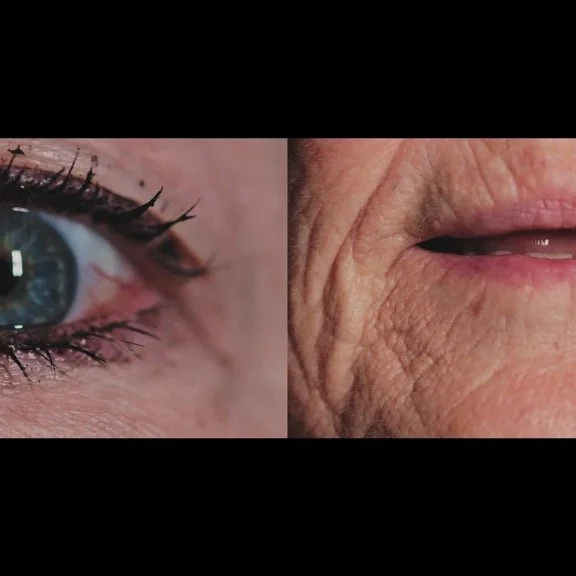
In my artistic practice, I often return to making personal narratives eulogizing the body as offerings. In the 1990s I created elegiac videos commemorating and mourning those lost to AIDS. It was important to make the body sacred again. When I became physically disabled in 1996, my work then celebrated maligned bodies.
I find hope in taking action, especially with other like-minded artists. No different than political street protests throughout my lifetime, i.e., the 1968 Democratic convention in Chicago, Gay Liberation marches in New York, and No Kings rallies today.
After last fall’s elections, I was afraid. I’m 73 years old, paraplegic and queer. I feared for my community and reached out to friends to participate in a new project asserting our corporeal agency. I needed to feel safe. Joining me were cisgendered and trans folks, queer and straight, with varying abilities. . . .

Like AI, We Get Stuck on Old Models
This is an excerpt from Ian Leslie’s Substack, where he lists—based on the ideas of Andrej Karpathy, a founder of OpenAI—four other “failure modes” shared by AI and humans.
A machine learning model gets trained on human data—photographs; Reddit forums; Amazon reviews; books and music and so on. We’re already at the stage where the big models have hoovered so much of this data into their maws that finding fresh sources to train on is hard.
AI models have no problem producing data, however, so the obvious answer is to train on data from other models. Indeed, this is inevitable, as the internet becomes swamped by LLM-generated text and images.
But there’s a problem with this. Model-generated data tends to be more predictable and less diverse than human data, as it imposes statistical patterns on the infinite variety of human outputs. Over time, this creates a feedback loop. Each new iteration of the model inherits the biases and errors of the previous one, but with less variety and signal.
Eventually, the model converges towards—or collapses into—the generic and repetitive. It loses accuracy, nuance, creativity until only a thin and colorless monoculture remains. This is “model collapse.”
Damn those machines, erasing the incorrigible plurality of human minds! …
Halloweens Past
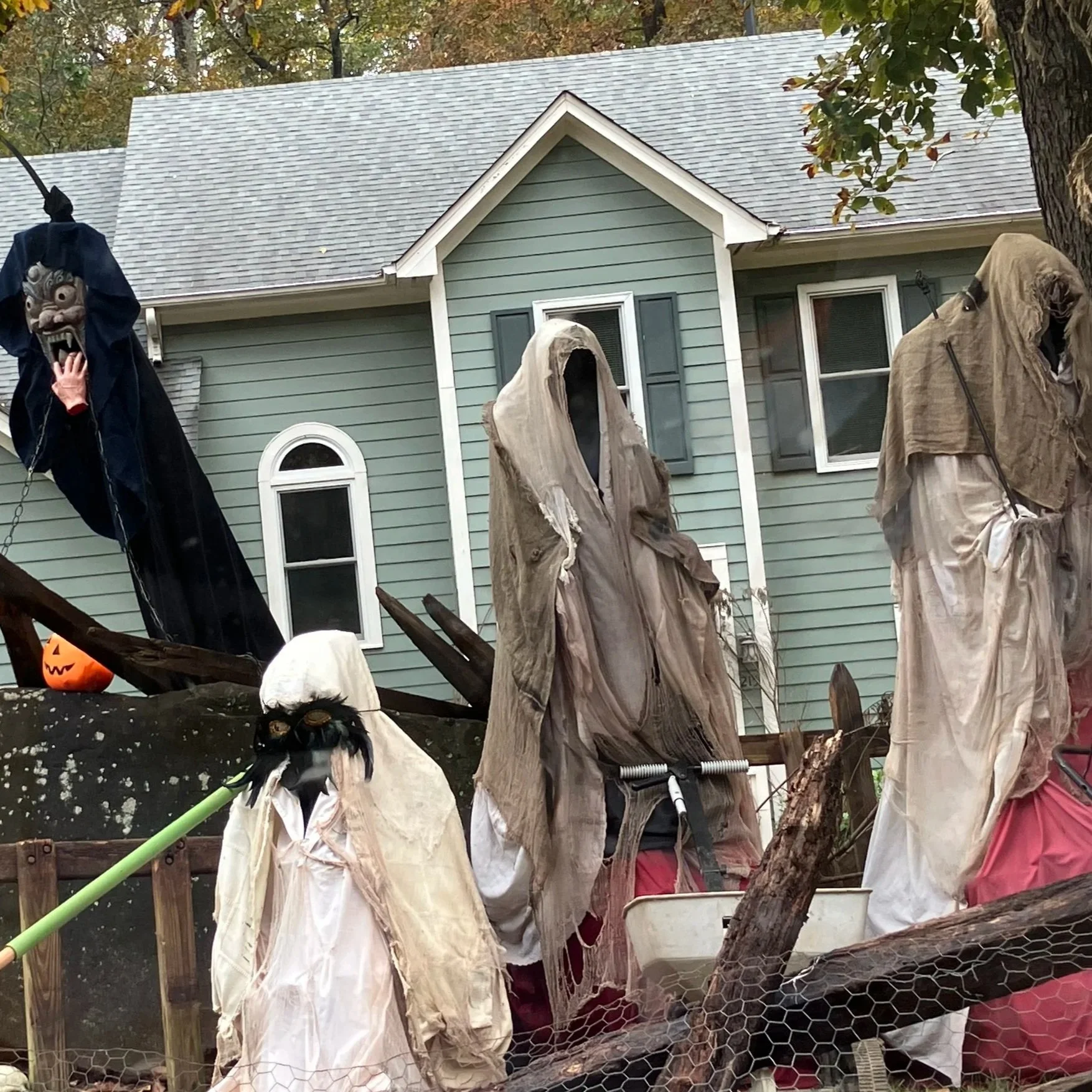
There were no inflatables.
On Halloween, back when we were kids, maybe our parents found some old white sheets and cut out eye holes and drew a scary smile with magic marker and we were ghosts. Maybe some of the kids wore makeshift eye patches and blackened a tooth here and there and they were ghouls. Some of us had applied temporary tattoos of skeletons on our forearms and we were . . . whatever we were.
We did, maybe, a little trick-or-treating, off by ourselves, parent-less, knocking on doors of neighbors we knew, hoping for some Rice Krispie treats. But we actually preferred the tricks. . . .

The Politics of Springsteen’s Nebraska and the Film About It
I found myself irritated and dumbfounded that out of all the fulsome discussion of the film, except for a line at the end of the always incisive Richard Brody’s review in TheNew Yorker, and, yesterday, Carl Wilson at the end of his Slate review, it was being taken as solely a picture about a personal crisis, when at the time, in 1982, the Nebraska album seemed so plainly a matter of a person addressing himself to a social and political crisis, and trying to paint a picture of a nation whose cords were fraying, or being ripped up and out as a social and political project.
So here, from the moment, is how it looked then. . , how it looked to me:
. . . Nebraska (CBS)—recorded last January in Springsteen’s New Jersey living room with acoustic guitar and harmonica, with a bit of synthesizer and an occasional backing vocal added later—is the most complete and probably the most convincing statement of resistance and refusal that Ronald Reagan’s USA has yet elicited, from any artist or any politician. . . .
This is an excerpt from Greil Marcus’ Substack. We encourage you to read the entire piece.

At War With Insomnia
The other morning, it was 2:50 a.m. The night before that, 3:35. One time last week, didn’t make it past 2. Last night, gratefully made it all the way to almost 4 a.m. before, of course, waking up.
I have insomnia, and, you know, I am not alone.
Up to 60 percent of people our age have some symptoms of insomnia. That could manifest itself by more than occasionally not being able to fall asleep or not being able to stay asleep or just waking too early. Almost a third of us get less sleep than is recommended. Around a quarter of us have enough symptoms, or a sufficient frequency of symptoms or severe enough symptoms, to meet the criteria for the chronic condition of insomnia disorder.
Like many of us, it was not always that way for me. . . .

This Won’t Be Humankind’s First “Intelligence Explosion”
….The biggie will apparently be when computers, in their ever-increasing wisdom, themselves figure out how to design and program computers that are significantly smarter than are computers designed and programed by mere suck-at-chess, barely-able-to-sustain-iambic-pentameter humans. Then the snowball will expand as it rolls—exponentially.
Gosh!
Whoa!
But also: Oy vey!
And we might be tempted to add: Incomprehensible!
But I might have a wee bit to contribute to the ongoing struggle to comprehend.
For I maintain, such a dramatic leap in astuteness is not unprecedented. This ain’t humankind’s first “intelligence explosion” . . .

Our Aging Plan? No Plan
Nick and Annie have moved to a continuing care retirement community. Bob and Alicia are on the waiting list of another retirement home. Joyce has moved closer to kids and grandkids in Colorado. Louisa and Teddy, who are on several waiting lists for continuing care places, have moved into a 55+ community. A number of other couples we know have downsized to homes or townhomes or apartments with just one level, no steps and no maintenance obligations.
Our plan? Our plan is that we don’t have any plan. . . .

It’s World Series Time—And Why It Matters to Me
. . . October is my month of remembrance and reflection: my wedding anniversary, my parents' wedding anniversary, my last World Series with Daddy. In the film “Field of Dreams,” Terrence Mann (James Earl Jones) declares "baseball has marked the time" and I couldn't agree more.
Quite often, the supreme Jewish Holy Day of Yom Kippur occurs in October. We gather with family, reflect on the year just past, and retell the stories of Yom Kippur from childhood. With pleasure I recall the World Series games played in the daytime when a transistor radio provided my friends and me the briefest but oh-so-satisfying connection with baseball in the midst of the depressing liturgy of sins and atonement.
The ultimate World Series and Yom Kippur story is from 1965 when star Dodgers pitcher Sandy Koufax (along with his manager and all the Jewish people in Los Angeles) prayed for rain so the first game of the World Series would not occur on Yom Kippur, when the Jewish Koufax would decline to pitch. . . .

The Case for Independent Travel
The Sicilian town of Taormina is remarkably beautiful, clinging to a cliff above the sparkling Ionian Sea. It is also quite inaccessible—the only way to get there is up a dizzyingly corkscrewing road, navigating an endless number of switchbacks.
And yet: on a recent trip there, we found the tight, winding streets of this seemingly remote place filled with … tour groups. Blame the second season of “The White Lotus,” which was filmed here. Or just blame packaged mass tourism.
Endless groups of 20 or 30 people, their blue-tooth lanyards hanging from their necks, straggled through the Porta Messina, following the leader, the one at the front of the gaggle with the flag or the umbrella. . . .

aretha in 1967
By April 22, 1967 Aretha Franklin’s single “I Never Loved a Man” was number 9 on Billboard‘s Hot 100, shortly to sell a million-plus copies. Defying conventional record-business wisdom (let a hit song run its course), Jerry Wexler [co-owner of Atlantic Records, who produced Aretha Franklin] let fly with “Respect” on April 13th. By June 3rd, it was Aretha’s first number 1 and her second million-seller in four months.
According to Wexler, when he played Aretha’s “Respect” for its writer, “Otis [Redding] broke out into this wide smile and said, ‘The girl has taken that song from me. Ain’t no longer my song. From now on, it belongs to her.’ Then he asked me to play it again, and a third time. The smile never left his face.”
“Respect” could hardly have meshed more closely with the times. . . .
(This is an excerpt from Tony Scherman’s excellent Substack: Among the Musical, which is full of similarly marvelous insights and stories about the music of our generation.)
Where News Is to Be Found Today
…...Despite all the changes in journalism I have seen in my historical research and encountered in my lifetime I am being surprised once again by how journalism is being transformed right now, in front of our eyes.
We are now being forced to navigate our way through yet another new news world. And my relationship to journalism is changing once again.
Yes, my first news stop in the morning remains the New York Times—as it has been since my parents were required to buy me a (discounted) subscription in sixth grade.
But I now choose to encounter The Times exclusively on the magic phone I carry in my pocket. Even the newyorktimes.com website now seems a bit hoary, old-fashioned. And, on the rare occasions when I catch a glimpse of the actual emaciated remnants of The Times’ old incarnation as a stack of newsprint, it is usually at the house of someone even older than I, and it seems an artifact of days gone by—like a Roman coin or a 1960s Buick. . . .

Works of Affirmation
In these dire times of erasure and annihilation, Eli Clare and Angelo Madsen, two queer trans artists, have released powerful works of affirmation.
A genderqueer person living with cerebral palsy, Eli Clare (https://eliclare.com ) uses writing as a bully pulpit against trans and disability oppression. His newest book, “Unfurl: Survivals, Sorrows, and Dreaming” (Duke University Press), interweaves creative nonfiction prose, poetry, memoir, history and advocacy. Painful flashbacks of childhood abuse are mixed in with erudite critiques of classifications and nomenclature and dreamscapes filled with gorgeous environmental metaphors.
Resiliency and healing are central concerns. Tender meditations on stumbling strides and crawling across forest floors are used as invitations to others to break normative strictures and “scoot, slide and crawl” with him. Timid teenage poems are reconceived to become examples of empowerment. Intergenerational trauma is examined, not to forgive, but to break the chain of “survivor turned perpetuator.” . . .