

One of the greatest guitarists in the heyday of American soul music and R&B was a white guy who grew up in segregated Memphis, Tennessee.
Steve Cropper, who died this past week at the age of 84, was an essential musician and songwriter behind the emergence of the Stax/Volt record label, which brought Otis Redding, Sam & Dave and many others to the forefront of American pop music. Later in his career, Cropper had his greatest financial success as a guitarist in the Blues Brothers Band, fronted by John Belushi and Dan Aykroyd of “Saturday Night Live” fame.
Cropper’s greatness did not arise from lengthy, showy guitar solos like those of blues greats such as B.B. King, Eric Clapton or Buddy Guy. Rather, his contributions were more subtle, adding whatever was necessary – a pulsating rhythm or a scorching fill - to make a song better. In this way, he’s similar to Keith Richards of the Rolling Stones, a musician more interested in playing propulsive rhythms and catchy riffs than long solos.
Booker T. and the MGs, Green Onions.
The songs Cropper was involved with include some of the essential recordings of the ‘60s and ‘70s: “Green Onions,” the hit instrumental from 1962 with his band Booker T. and the MG’s; “(Sittin’ On) The Dock of the Bay,” Redding’s posthumous Number One hit which was co-written by Cropper; “Soul Man,” the boisterous Sam & Dave single; “In the Midnight Hour,” Wilson Pickett’s monumental soul hit, also co-written by Cropper; and the Staple Singers’ “I’ll Take You There.”

Steve Cropper, right, with Sam and Dave.
Born in Missouri in 1941, Cropper’s family moved to Memphis when he was nine years old. He started playing guitar at 14 and formed a band called the Mar-Keys (originally named the Royal Spades) which actually had a hit recording in 1961 with the instrumental “Last Night.”
Cropper was already doing session work with Memphis’ Sun and Hi record labels when he began working for the fledgling Stax Records in 1962. He became the guitarist in Booker T. and MG’s, an instrumental combo featuring three black musicians (Booker T. Jones on organ, Al Jackson, Jr. on drums and Lewie Steinberg on bass) and one white (Cropper), with another white player, Donald “Duck” Dunn, replacing Steinberg a few years later. It was in 1962 that the band recorded its biggest hit, “Green Onions,” that helped establish the funky Stax sound – a grittier and rougher-edged sound than most of the hits emanating from Detroit’s Motown Records.
The quartet soon became the label’s house band, performing with virtually all of Stax’s singers and groups. Cropper also became the the label’s main record producer and head of A&R (Artist and Repertoire, in charge of discovering and overseeing new talent).
One of the ironies of segregation in the American South in the early 1960s was that an interracial band like Booker T. and the MG’s was legally barred from performing together on stage. However, working together in the confines of a recording studio apparently escaped the unwanted attention of those who tried to maintain Jim Crow racial separation.
Click here for Steve Cropper discussing and playing “Knock on Wood.”
Cropper and other Memphis-based musicians began to receive greater international acclaim in early 1967, when the Stax/Volt Revue (aka “Hit the Road, Stax”) toured Europe. With Booker T. and MG’s both performing as a group and serving as the house band, the tour showcased Redding, Sam & Dave, Arthur Conley, Eddie Floyd (his “Knock on Wood” was co-written by Cropper), the Mar-Keys, Al Bell and Carla Thomas.
The tour was a financial and critical success, with one British music writer signing off his article “Yours till Steve Cropper plays a bum note,” and the Beatles, in the midst of their “Sergeant Pepper” recording sessions, greeting Cropper by bowing down from the waist in unison. But according to Peter Guralnick’s “Sweet Soul Music: Rhythm and Blues and the Southern Dream of Freedom,” the tour did lead to animosity among the various musicians, as some resented Cropper’s emergence as a spokesman who was doing a lot of the press interviews.
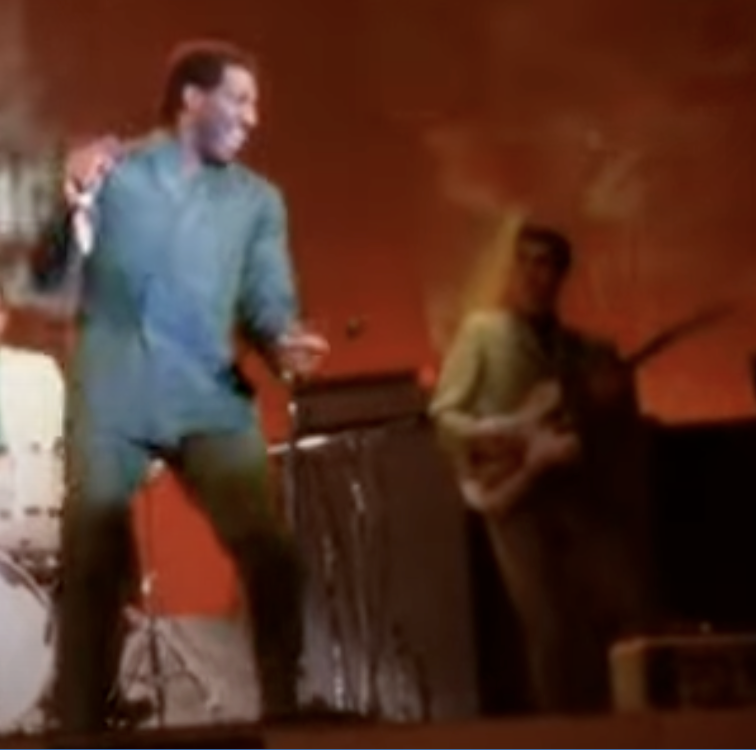
Otis Redding and Steve Cropper on stage at Monterey Pop, 1967
Later in 1967, Cropper and Booker T. and the MG’s backed Redding in his soon-to-be-famous performance at the Monterey Pop Festival, which helped introduce Redding to a still wider, and whiter, American audience.
In early December 1967, Redding and Cropper finished recording sessions for “(Sittin’ On) The Dock of the Bay,” a song they co-wrote, with Booker T. and the MG’s and the Mar-Keys’ horns providing the instrumental backing. Slower and sweeter-sounding than most of Redding’s hits, the initial lyrics were written by Redding while staying on a houseboat in Sausalito that had been loaned to him by San Francisco concert producer Bill Graham, with Cropper later expanding the lyrics and developing the instrumentation. The song reflected both Redding’s homesickness as well as a sharp commentary about the slow path to overcoming racism in America (“Looks like nothing’s gonna change/Everything still remains the same”).
Two days after the sessions concluded, Redding and some young musicians in a new Stax/Volt band called the Bar-Kays died in a plane crash near Madison, Wisconsin. Redding was 26 years old and on the verge of major stardom. Cropper than finished mixing the song, adding the sounds of waves and seagulls that Redding had intended. Shortly after its release in early 1968, “(Sittin’ On) The Dock of the Bay” went to Number One on the U.S. charts and became Redding’s best-selling single. It would later win Grammy Awards for best R&B song and best male R&B vocal performance.
Cropper remained with Stax until the early ‘70s, when he left the label and began working with a bunch of notable musicians in Memphis and Los Angeles – including John Lennon, Ringo Starr, Rod Stewart, John Prine, Jeff Beck, Tower of Power and Levon Helm.
Booker T. and the MG’s announced the band’s reformation in 1975, but Al Jackson’s tragic murder in his Memphis home in the same year ended those plans. But a subsequent reunion of the MG’s (with Steve Jordan on drums) produced “Cruisin’,” a Grammy-winning song for best pop instrumental performance, from the 1994 album “That’s the Way It Should Be.”
Cropper’s greatest commercial success came later in the’70s with his involvement as a member of the Blues Brothers. Led by John Belushi and Dan Aykroyd, who first began to develop the concept of the blues-loving Jake and Elwood in a skit on “Saturday Night Live,” Cropper became part of a combo formed in 1978 that also included Duck Dunn, Matt “Guitar” Murphy, Lou Marini, Tom Malone and Alan Rubin. The band had their debut on “Saturday Night Live,” and their first album, “Briefcase Full of Blues,” recorded at a live performance from the Universal Amphitheater in Los Angeles, hit Number One on the charts.
The group’s 1980 film comedy, “The Blues Brothers,” directed by John Landis, was one of the top 10 grossing movies of the year. The cast included such R&B stars as Aretha Franklin, James Brown, Ray Charles and John Lee Hooker.
John Belushi died in 1982, but a 1998 movie sequel, “Blues Brothers 2000,” again included Aykroyd, Cropper and the rest of the original band, joined by John Goodman as a new vocalist and a host of R&B and blues stars. However, the new film was poorly received by both critics and the public.
Although Cropper and the other musicians received some criticism for their Blues Brothers involvement for allegedly “selling out” their music for some Hollywood bucks, Cropper defended his participation. In a 1998 documentary included on a DVD release of “The Blues Brothers,” Cropper maintained that Belushi was as good a singer as many of the performers he had played with in the past.
Cropper continued to record and perform throughout the next decades. He was featured in several major festivals and concerts, including “Guitar Legends, Seville (Spain) 1991,” Bob Dylan’s 30th Anniversary Concert in 1992 and Eric Clapton’s “Crossroads Guitar Festival” in 2004. In the 2000s he recorded with both Felix Cavaliere (The Rascals) and Frank Black (The Pixies). His 2021 solo release, “Fire It Up,” received a Grammy nomination for best contemporary blues album, and he was still active in 2024, when he released an album entitled “Friendlytown” under the band name Steve Cropper and the Midnight Hour.
Booker T. and the MG’s were inducted into the Rock and Roll Hall of Fame in 1992, and in 2005 Cropper was inducted into the Songwriter’s Hall of Fame.
Steve Cropper was not only an outstanding musician, songwriter and record producer, but he’s also a symbol of what was best about the 1960s. He was the ultimate team player as part of Booker T. and the MG’s, the band that formed the solid block on top of which so many great performers built their music. Though he was never known as an activist, his life and work broke down racial barriers in the American South. He leaves a legacy that will long be remembered and celebrated.